
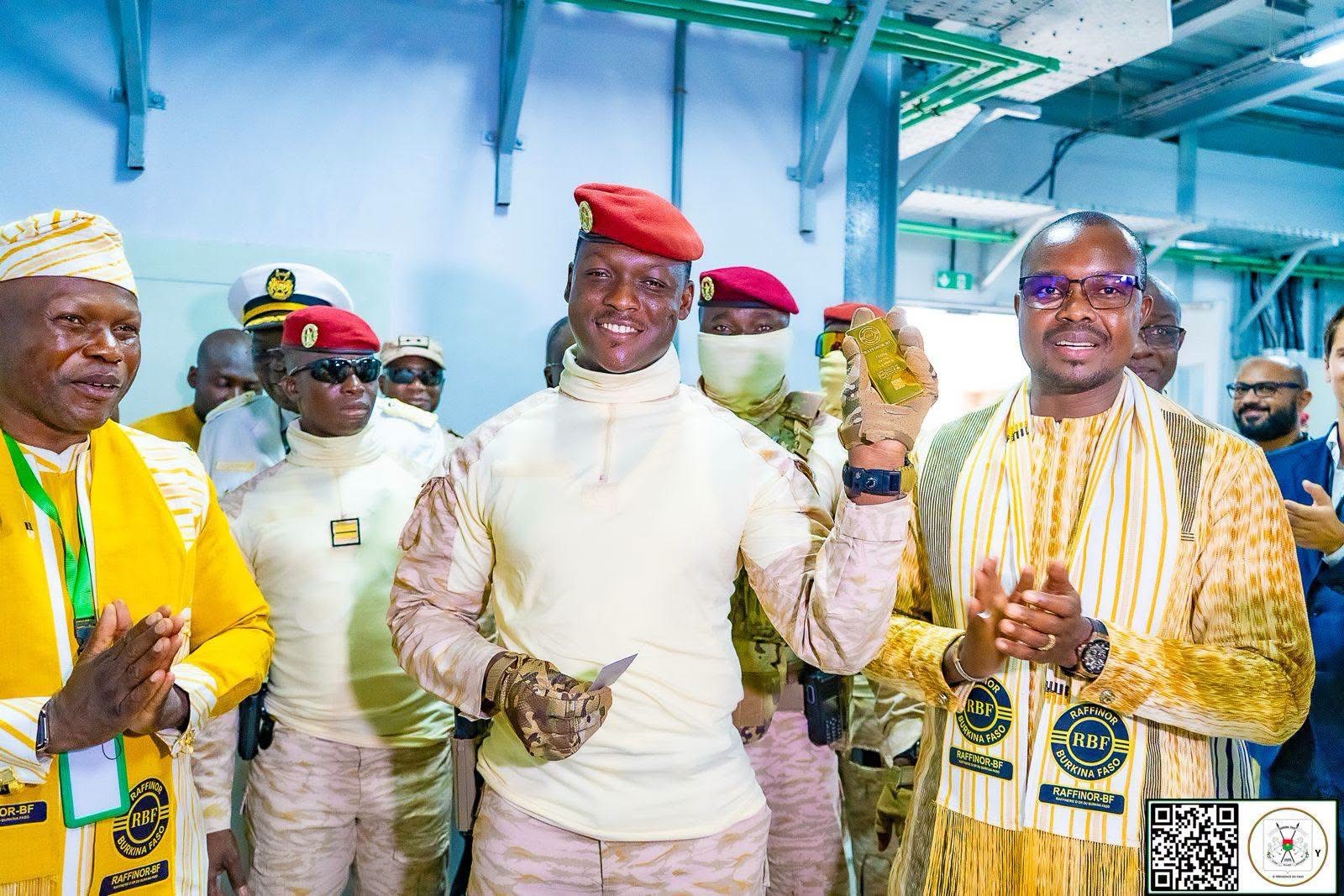
On Monday, in the Ouaga 2000 district of the capital, Captain Ibrahim Traoré was handed a gold bar that had been refined entirely inside Burkina Faso. It was the first of its kind for a country that has mined gold for years but has historically sent much of it abroad for refining. The bar came from Raffinor-BF, the country’s first gold refinery, which the presidency called “a historic step” toward economic independence. For Traoré’s military-led government, the plant is meant to show that Burkina Faso can control more of its most valuable export from the mine to the ingot.
The reasoning is simple. Gold is Burkina Faso’s leading export, ahead of cotton, and the mining ministry says the country produced more than 94 tonnes in 2025 from 15 industrial mines and a number of semi-mechanised operations. Much of that production has left the country as doré, a rough alloy that is refined elsewhere. With the refining taking place abroad, part of the value created by the gold is also captured elsewhere. “We want the entire value chain to be based here,” Traoré said at the opening. Mining Minister Yacouba Zabré Gouba put it more bluntly, calling it the day the country would “take back the keys to our own house.”
The plant sits on a five-hectare site and includes a foundry, a laboratory, secure storage and a jewellery workshop. It was built to international standards and will turn doré into fine gold bars of 99.99% purity. Construction began in November 2023 and cost more than 11 billion CFA francs, roughly $19 million. The money came from the state, through the national precious metals company SONASP, and from Burkinabè private investors. Officials expect the refinery to create 100 direct jobs and around 5,000 indirect jobs.
The capacity figures are where the ambition shows. Raffinor-BF can initially process 164 tonnes of gold a year, well above what the country currently produces, and the government says it could reach 515 tonnes in a second phase. That extra room is deliberate. Authorities want Burkina Faso to become a regional refining hub, which would mean handling gold from neighbouring countries as well as its own. Officials also say the plant could eventually take in the output of both industrial and artisanal miners.
The refinery fits into a wider push since Traoré took power in a September 2022 coup. His government created a state-owned mining company two years ago, and reforms to the mining sector have increased the state’s stake in new mining projects to 15% while requiring companies to contribute to the training of local workers. At the opening, Traoré also urged young Burkinabè to build advanced technical skills, suggesting that the government sees the refinery as a source of training as well as jobs.
But the refinery’s biggest test may begin after the ceremony.
The authorities have struggled to regulate the informal mining sector, which has been hit by jihadist violence, and a refinery operating well below capacity would limit the economic value the government hopes to capture. A plant that can process far more gold than Burkina Faso currently produces will need a reliable supply of domestic production moving through official channels, or gold from neighbouring countries willing to use the facility. How that will happen remains unclear.
Another question lies further down the value chain: who ultimately benefits when the gold is refined at home?
The government has set out the number of jobs it expects the refinery to create, but the broader economic impact will depend on what develops around it. That could include technical services, transport, security, equipment maintenance, gold trading and jewellery manufacturing. It will also depend on how the refined gold is sold, certified and traded, and how much space Burkinabè businesses and workers have to participate in those activities.
That distinction matters because refining gold locally does not automatically mean that all of its economic value stays in Burkina Faso. The refinery can change where the metal is processed. The harder question is whether it can also change who captures the value created around it.
For now, the first bar exists, and it was made at home. Raffinor-BF has given Burkina Faso a new piece of infrastructure and a way to take control of another stage of its gold industry. Turning that capacity into a functioning domestic and regional business will depend on more than the refinery itself. It will depend on the mines that supply it, the roads and systems that move the gold, the security conditions around production, and the policies that determine who participates in the chain.
For a country whose mineral wealth has long been measured by what it can take from the ground, Raffinor-BF represents a different measure of value: how much of that wealth can be processed, traded and built upon at home.
