
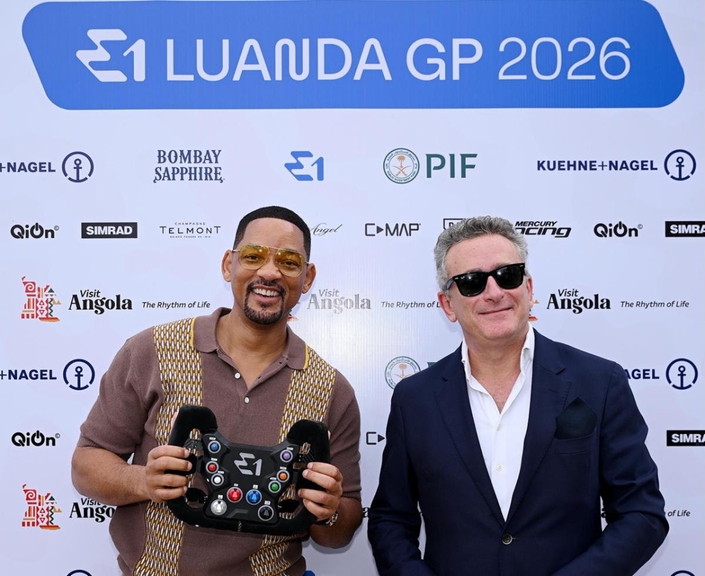
The curtain has fallen on the E1 Luanda Grand Prix. The boats have left the bay, the celebrities have gone home and the race weekend has ended. For Angola, however, the event marks the beginning of a longer-term experiment.
Through a three-year partnership with the UIM E1 World Championship presented by PIF, Visit Angola is using international sport to support a broader tourism and investment strategy.In interviews with TIME Africa, E1 CEO Jamie Copas and H.E. Márcio de Jesus Lopes Daniel, Minister of Tourism of the Republic of Angola, discussed the thinking behind bringing the championship to Luanda and the opportunities the partnership could create beyond the race itself.
“For us, it was an opportunity to tell a more contemporary story about the country,” the Minister said. “Angola has an extraordinary natural and cultural heritage, but it is also a country that is creating the conditions to host international events, attract investment, develop new tourism experiences and take part in new economies.”
That strategy extends beyond the race itself. Visit Angola is also the main partner of Will Smith’s Westbrook Racing, formally known as “Team Westbrook by Visit Angola.” The partnership connects Angola’s tourism brand to a team operating at the intersection of sport and entertainment.
“I think it’s for us to help tell Angola stories. I think it’s also for Angola to help tell ours. It’s about that collaboration and partnership,” Copas said.
The country’s broader tourism figures show why attracting international visitors remains important. Angola recorded 223,140 international tourist arrivals in 2025, 2.6% above its 2019 level, according to UN Tourism. The figure marked a 28% increase from 2024 and took arrivals above the country’s pre-pandemic level for the first time.
That gap is central to Angola’s tourism ambitions. The government is seeking to expand leisure tourism around the country’s coastline, natural attractions and cultural offerings while creating the infrastructure and private-sector capacity to support it.
Under PLANATUR 2024–2027, Angola aims to attract four new large international investors, five privately built hotels, add 3,175 hotel rooms and create 50,000 cumulative new jobs. Those targets are not specifically tied to E1, but they provide a measure of the wider economic strategy into which the partnership fits.
Sport has already demonstrated some of that potential. During AfroBasket 2025, Angola recorded 26,414 tourists, while average hotel occupancy reached 69.3%. The government estimated approximately Kz210 million in tourism-related activity across accommodation, restaurants, travel agencies, guides, transport and car rentals.
E1 offers a different model. The Luanda Grand Prix was distributed across more than 230 territories and linked Angola to an international championship spanning sport, entertainment, technology and sustainability.
The Minister described the personalities surrounding E1 as part of that strategy, rather than an end in themselves.
“The personalities associated with E1 are entry points into a much larger story about Angola. They help generate attention. It is up to us to turn that attention into curiosity, consideration and, finally, concrete travel and investment decisions.”
The three-year partnership gives Angola time to assess whether international sport can contribute to objectives already embedded in its tourism strategy. Its impact cannot yet be measured in isolation, particularly as the partnership is only beginning.
“We want to move from awareness to consideration, from consideration to the visit, and from the visit to more economic activity, more investment and more employment,” the Minister said.
The opportunity also extends beyond Angola. Lagos hosted E1’s inaugural African race in 2025, while Team PRONC, backed by a consortium of Nigerian entrepreneurs, is set to become the championship’s first African-backed team when it enters the competition in 2027.
That points to a broader shift in how African markets can participate in global sport, not only as audiences and hosts, but as commercial partners, investors and owners.
“We haven’t closed any doors with any of the conversations we’re having across the continent. We’d welcome it. We would like to do more races here,” Copas said.
For Angola, that makes E1 more than a test of whether a major sporting event can attract attention. It is a test of whether an international sports property can become part of a country’s economic strategy by helping build tourism demand, private investment and new commercial opportunities long after the boats have left Luanda.
As E1 expands across the continent, African markets are beginning to occupy more positions within the global sports economy: as hosts, partners, investors and, increasingly, owners.The Luanda Grand Prix was one event. The more consequential story may be what Angola, and the wider African sports ecosystem builds around it next.