
At the United Nations General Assembly in New York, President Duma Gideon Boko was speaking to a world where trust in the international system is under strain. For Botswana, the stakes are different from those of the major powers. Its influence has never rested on military might. It has rested on diplomacy, stability and the protection of a rules-based order.
Addressing the 81st session of the General Assembly on September 23, Boko called for a renewed commitment to multilateralism, arguing that international rules lose their authority when they are applied selectively. He urged countries to return to dialogue as the first instrument of diplomacy and turned the same scrutiny on the global financial system, where developing countries often face borrowing costs that leave governments with less room to invest in their people. Reform, he argued, is no longer optional if multilateral institutions are to retain the trust of the countries they are meant to serve.
There was a distinctly Botswana argument running through the address. A smaller state, Botswana has much to lose when international rules become a matter of power rather than principle. But Boko was also looking beyond the protections of the existing order. He called for a financial architecture that reflects the realities of the 21st century, particularly as developing countries confront climate change, technological transformation and the cost of capital. It was a speech about the world Botswana is navigating and, perhaps more importantly, the place it wants to occupy within it.
The first signs of a major recovery are appearing in a market that has spent the past two years testing Botswana’s dependence on diamonds.
In the United States, sales of natural-diamond jewellery at independent jewellers rose 8.8% in the first half of 2026, a figure Minerals and Energy Minister Bogolo Joy Kenewendo cited in New York this week. It is an important signal from the world’s largest natural-diamond market. At home, the state-owned Okavango Diamond Company sold about 855,000 carats for $200.7 million through its auctions in the first eight months of the year, even as the global market remained subdued.
That is why President Duma Gideon Boko’s warning to “beware, the power of the bounce back” carries more weight than a slogan about recovery. A rebound in demand would restore some of the revenue and confidence lost during the downturn, but it also comes with a reminder of how potentially vulnerable Botswana remains to movements in a global commodity market. The diamond market may be finding its footing again. For Botswana, the more consequential question is what happens when it does.
Kenewendo has been explicit about that shift. Botswana wants more of the industry’s cutting, polishing, trading, design, technology and branding to happen at home. Government estimates presented earlier this year put the global cutting and polishing market at about $34 billion, with jewellery and consumer sales representing another $75 billion. Botswana has acknowledged that it has yet to capture much of that downstream value.

That ambition gives the recovery a significance beyond Botswana’s borders. Across Africa, countries rich in minerals have been making the same statement: we must now move from exporting resources to building industries around them.Botswana’s answer is beginning to extend beyond diamonds themselves, toward skills, businesses, technology and investment that can remain in the country after the stone leaves the mine.
There is a certain symmetry with the argument Boko took to the United Nations days earlier. In New York, he called for a global financial system that gives developing countries greater room to finance their own development. Back home, Botswana is confronting the domestic version of that question: how much value can a resource-producing economy retain, create and reinvest for itself? The diamond market may be finding its footing again. Botswana is trying to make sure that when it does, the country benefits heavily.
The question after the diamond rebound is what Botswana wants the next cycle of growth to look like. At UNGA81, the answer was increasingly visible: the country is looking for investment that does more than finance existing industries.
One of the clearest examples came on September 24, when Botswana used a New York investment roundtable, held on the sidelines of New York City Climate Week and the UN General Assembly, to launch its National Renewable Energy Power Sector Plan and Clean Technology Manufacturing Policy and Investment Guide. The first provides a roadmap for scaling renewable generation towards Botswana’s 2030 targets, while the second identifies opportunities around clean-technology manufacturing and related industries, including solar photovoltaic value chains, with access to wider SADC, SACU and African Continental Free Trade Area markets. Minister Bogolo Joy Kenewendo described the instruments as a move towards “investment, industrial development and economic diversification.”
The digital economy is part of that calculation. At a Generation Unlimited Global Leadership Council meeting in New York, Boko linked artificial intelligence and green growth to jobs, entrepreneurship and foreign investment, arguing that Botswana needs the “right type of investment” to unlock opportunities for young people. The World Bank similarly says the country’s extractives-driven, public-sector-led growth model is reaching its limits, making stronger private-sector development important for investment, entrepreneurship and diversification.
Regional integration gives that ambition a larger market. During President Paul Kagame’s state visit to Gaborone in May, Botswana and Rwanda signed six agreements covering visa abolition, double taxation, air services, trade and investment, health, and a formal partnership between the Botswana Investment and Trade Centre and the Rwanda Development Board. Together they remove everyday barriers to moving people, money and goods between the two countries, and for Botswana, whose domestic market is relatively small, that access matters because the industries it hopes to build will need to reach beyond its borders. They also offer other African countries a practical example: two economies from different parts of the continent turning talk of integration into signed commitments that make it easier to travel, invest and trade across borders.
It also brings the argument back to the one Boko made at the United Nations. His criticism of an international financial system that leaves developing countries paying more to borrow was ultimately an argument about economic agency. The investment proposition Botswana presented alongside that speech carried the same underlying question: how can a country attract outside capital while using it to build more capacity at home?
Botswana’s diamond industry is also confronting a change in how natural diamonds are positioned in the global market. The rise of laboratory-grown diamonds – now known as synthetic – has made differentiation, provenance and consumer education increasingly important to natural-diamond producers, and Botswana has responded with a P13.2 billion marketing and consumer education campaign aimed at distinguishing natural diamonds from lab-grown synthetics. The campaign, developed with other African producers, is as much about reclaiming the story around natural diamonds as protecting their market. At the “60 Jewels of Botswana: The Diamond Story” showcase in New York, that history was placed within the country’s 60th anniversary story. Diamonds did not merely make Botswana wealthy. They became part of the country’s national identity and development story. Now, as Botswana marks six decades of independence, it is asking what that story looks like in the next 60 years.
But the next chapter is also about what happens beyond the mine. Botswana wants to move further into the diamond value chain, from trading and analysis to branding, technology and investment, so that more of the economic value stays within the country. Kenewendo has put the ambition plainly: “Diamonds cannot simply leave Botswana in their roughest form. They must leave Botswana as stories, as brands, as craftsmanship, as technology, as an investment, as luxury and as jobs that have been created here at home.” That shift gives the 60th anniversary a forward-looking dimension. The question is no longer only what diamonds have done for Botswana over the past six decades, but what the industry can help build in the next one.

There was another side to Botswana’s presence in New York: how the country was presenting itself to the world beyond its traditional diamond story. At a National Geographic and De Beers event on September 24, President Duma Gideon Boko appeared alongside Prince Harry, Venus Williams, Ciara, Letsile Tebogo and leaders from Botswana, Angola and Namibia as the Okavango Eternal partnership was renewed for another five years. But the significance of the gathering went beyond the visibility of its guest list. The Okavango Basin provides food, water and livelihoods for more than one million people across the region, and more than 95% of the water that sustains the Delta in Botswana originates in Angola. The renewed partnership therefore placed Botswana’s conservation story within a wider African one, linking environmental protection with communities, livelihoods, transboundary tourism and cooperation between the three countries. A conservation effort that still remains as one of the best statistically in the world.
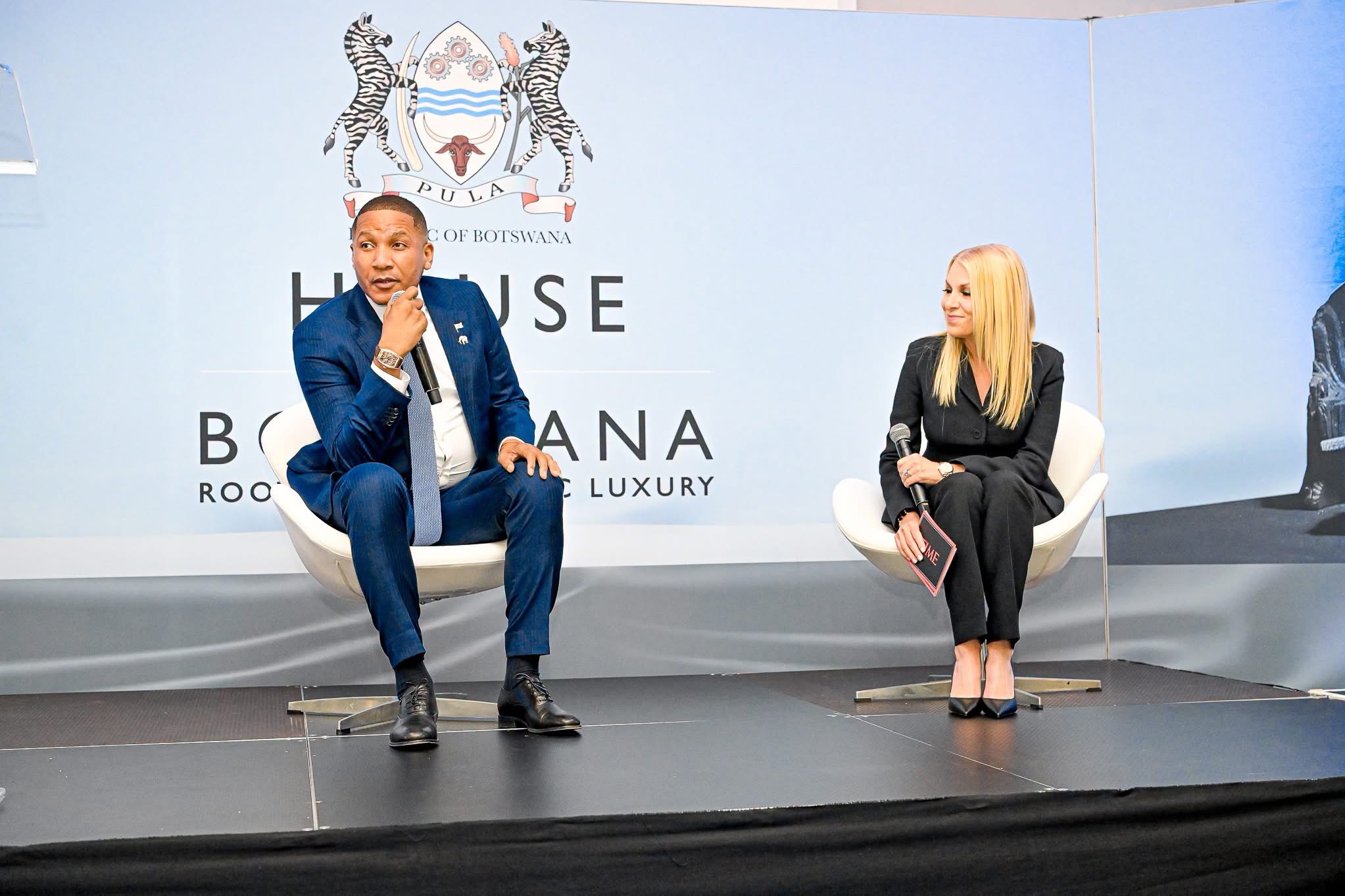
That effort to broaden Botswana’s global story was visible elsewhere in New York. At Soho House, the House of Botswana’s “Diamonds & The Delta” gathering brought together figures from music, culture, business and diplomacy, including Rapsody, Maino and Roy Woods, using contemporary culture as another entry point into the country’s story and its relationship with the global African diaspora.
A few weeks later, Botswana’s 60th Jubilee celebrations at Rockefeller Center placed that story on a larger stage, bringing together President Boko, government leaders, investors, cultural figures and artists to mark six decades of independence. Together, the events reflected a country increasingly conscious of the role culture can play alongside diplomacy and investment: not simply promoting Botswana as a destination or diamond producer, but building a more expansive national identity around its people, creativity, natural heritage and ambitions for the decades ahead.
That broader framing is important because Botswana is increasingly presenting its natural wealth as something that can support more than extraction. Its diamonds remain central to the country’s economic story, but the Okavango offers another way of thinking about value: as a source of water, tourism, livelihoods, conservation and regional cooperation. Storytelling is part of that effort too. National Geographic’s work around the Delta has supported local storytelling and Batswana filmmakers, while the renewed partnership includes investment in youth-led local storytelling alongside its global platform. In New York, these strands came together in a broader picture of Botswana: a country still shaped by its natural resources, but increasingly interested in how those resources, its people and its partnerships can define what comes next.
