
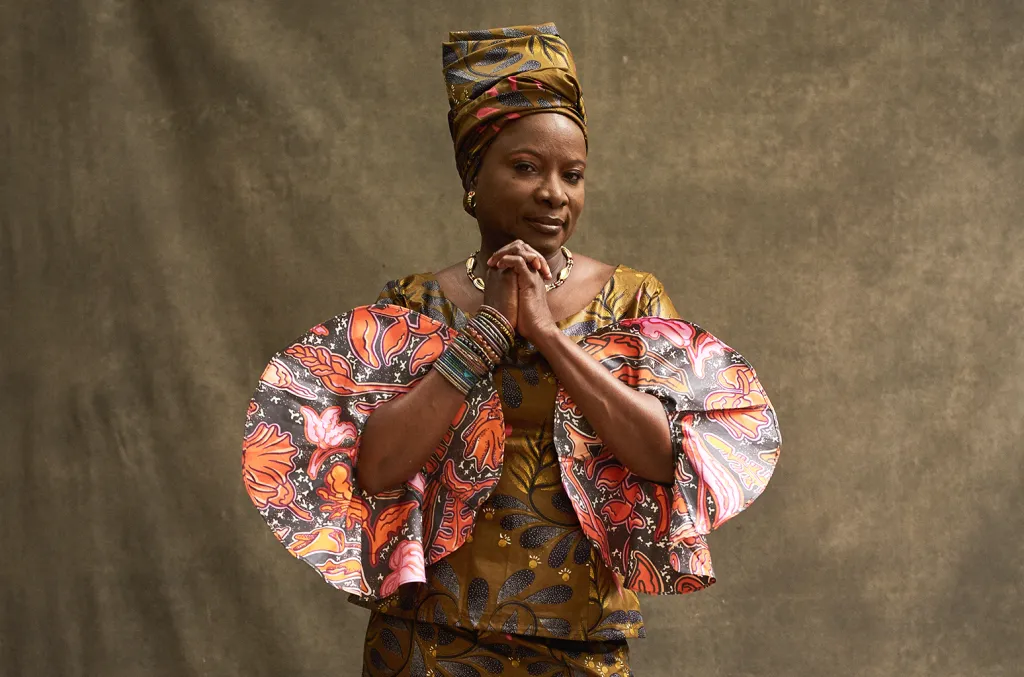
And when the time has come, the star will hold the door.
I have always deeply admired women who opened doors, and I have always made a point of thanking, while they are still alive, the rarer women who left those doors wide open behind them, so that the women who follow never have to climb through a window again.
When I secretly started writing this letter, before I even knew it would be published, it was July 14th and I was in Ouidah, on a writing residency. July 14th is the day you were born, in that very city. It is also Saint Camille’s Day. So, during a break from a novel that was going nowhere, I wrote you a letter that, unlike the novel, was moving forward in leaps and bounds. I found myself talking to you, and I think that’s the only honest way to start a letter like this one: by acknowledging that it arrived the way things arrive in Ouidah, without warning, with a clarity and an insistence you just don’t argue with.
The first time we met, you didn’t say hello. You were standing behind me, you tapped my arm the way aunties and mamas do the world over, women who need no introduction before exercising an immediate, gentle authority, and you told me off. and you scolded me. “What are those heels? You’ll wreck your back!”
It’s been our joke ever since. Wherever we are, whatever the occasion, if I show up in heels, I know exactly what’s coming, and I also know I’ll wear the same pair again next time, just for the pleasure of hearing you say it.
It took me a while to figure out why that line hit me the way it did, and I eventually realized it was because of everything you hadn’t said. You didn’t tell me I was too tall. You didn’t tell me I took up too much space. You skipped all the things usually said to women who stand out, said to us early enough, with a smile, that we grow up mistaking them for tenderness. Instead you told me to watch my back, which means you already pictured me growing old, still around, years down the line. With the gentleness of a woman who has already turned every page and knows what it costs.
That is the Angélique Kidjo effect. That is the effect you have on every woman you meet. A spellbinding force, a devastating gaze full of humor, a strategist’s mind in the service of a struggle that ends in redistribution, always in that order. Your laugh wins everyone over; your comic timing deserves to be studied in acting schools, because only you can land a joke at the precise moment when an entire room holds its breath; and then there is that voice of yours: you drop it into its lower register, then let a silence fall so everyone has time to take the measure of what they have just heard.
There’s something we all love about women whose career fills up an entire room and who still, the moment they start talking to you, make space for you to sit down. You are one of them! We could spend the whole night listing what you’ve earned, and nobody needs to, because 3 minutes of conversation with you is enough to slide every award under something far rarer, the way you treat every woman who comes near you like a sister or a daughter, no hierarchy, no protocol, with the unstudied ease of women who have raised many. You make us want to take you home and make you tea. Family is the word that sticks to you, and it suits you just as well as queen.
Before you’re ever a queen, you dance. You stomp your feet, you shout, you sweat, every note takes you over before you’ve had time to decide anything at all, and nobody can watch you dance without wanting to dance too. A promise your body made to music somewhere between Cotonou and the rest of the world, and one it has never broken. Three seconds of music, snatched from anywhere, and there you are.
In 1983, curled up in an airplane seat, you were praying to every god you’d ever been given, plus a few more borrowed along the way, while Cotonou shrank beneath the wing. Your father had driven you to the airport in tears, certain he would never forgive himself if anything happened to you. A customs officer, a musician friend of your brothers, looked away just long enough for you to run, and he never again received a promotion or a raise. He never regretted it either, which, in a country where even silence got watched, already counted as a feat.
In Paris, everything had to be rebuilt from almost nothing: the nightclubs, the jazz school where two classmates told you jazz wasn’t for African women, the hairdressing, hotel rooms to clean, babysitting to cover a tuition that wasn’t even yours. We tell life stories once they’ve reached the light. We rarely tell the nights that paid for them.
Maybe that’s why you’ve never mistaken being saved for being free and clear…
You invented Batonga as a kid, as a comeback to people who swore girls had no business in a classroom. You didn’t know yet it would become a foundation, you just knew you needed a word to hold your ground. Your best friend, your confidante, vanished one morning without warning, married off before she had finished secondary school, and out of your entire class only two of you had made it that far. It took you forty years to turn that childhood grief into a method: seeking out girls where no one else looks for them; listening to mothers with no men present; revising the model after testing it; never letting brainwashing, whether religious or traditional, come near them.
You didn’t just promise girls they could dream, you went after the one detail that separates a promise from an actual shot: the price tag.
Then the question packed up and moved, from the classroom to the bank counter, and you followed it there without blinking. At the G7 summit in Biarritz, you carried the voice of the continent’s women entrepreneurs all the way to $251 million. A quarter of a billion, pried out of leaders who are a lot more used to applauding you than to actually funding you. I love how politically brutal that number is, because it says what speeches usually hide: emancipation never gets paid in compliments.
This is where your work spills past music without ever fully leaving it behind. Audre Lorde wrote that poetry is not a luxury. You proved the flip side of that, showing that a girls’ club, a guarantee fund, and a summit negotiation can earn the name poetry just as legitimately as three verses and a chorus can. Toni Morrison put the responsibility for living language in our hands. You took a child’s retort, “Batonga,” and made it the name under which thousands of women learn, every day, to stop asking permission to exist.
For you, passing things on comes down to one simple rule: take from an elder, hand down to someone younger, and never claim the right to keep the crown for yourself. Miriam Makeba crowned you queen of African music from a stage one night, and you say your first thought was that she had lost her mind. A woman who came before you handed you a crown you had not asked for. You could have kept it. You passed it on. Decades later, dedicating your own Grammy to Burna Boy competing against you in the same category, you announced from that same stage that the time had come for an entire generation, before going on to build a whole album around that generation. Those artists no longer had to run toward a plane to become giants. They got to stay home, build businesses, create at home, and how deep their roots run measures, down to the meter, exactly how far things have come since your exile.
For you, inspiring people has always been about making room, expanding, for everyone else, the surface area of what’s possible.
You’ve said that if you were there, others had to be there too, and that a door opened this way can never close again, not while the women coming up behind you keep walking through it in heels too high, with their films, their songs, their companies, and their own definitions of freedom.
This sidewalk doesn’t move on its own. What moves is the list of who gets to be on it, and every name added to that list shifts, for everyone, what counts as worth remembering by History, a a shift that never happens of its own accord and that, each time, someone must be willing to force into being.
That work of shifting things has never, for you, stayed confined to music. It ran through theater the day you handed your daughter the job of writing a play about slavery in Ouidah and let the painter Kerry James Marshall design the sets. It crossed into poetry the night you made Senghor’s verse resound through the Cour d’honneur of the Palais des Papes, a place that, since 1947, had allowed only one other Black author to take that same stage. It ran through film when your voice, sung in Fon, closed out the credits of a Hollywood movie about the women warriors of Dahomey to a close. What is sometimes called your power to inspire beyond music is, in truth, rooted in a much older habit: seeking, in every discipline you move through, in every field you step into, the same thing you’ve spent your whole life chasing on a stage, a place where too narrow a definition of who gets to tell what story finally gives way, because of you.
On this day, Angélique, my thoughts turn to the woman who used to say that kindness is a bulletproof vest and joy an act of resistance. I wish I could’ve recorded his voice too, you know who I mean, and slip it into your ear as you walk toward your star. One earbud for you, one for Naïma, as always, hand in hand, headed toward everything that’s great.
The time has come, Angélique. A thousand thanks,