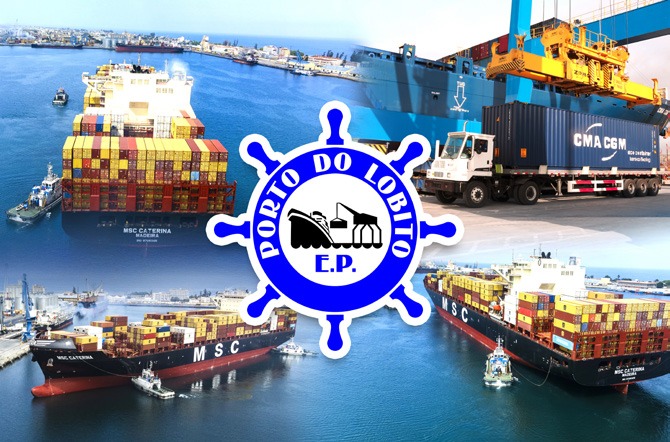

A century-old trading heritage is being reshaped into a modern logistics platform connecting Angola to regional and international markets while supporting industrialization, diversification and local value creation.
On Angola’s Atlantic coast, Porto do Lobito is reviving its historic role as a critical trade connection while positioning itself as a modern platform for industrialization and regional integration. Founded as a commercial port in 1928, Lobito served for almost a century as one of the main maritime access points for Angola’s interior and the mineral-rich regions of what are now the Democratic Republic of the Congo (DRC) and Zambia. Today, as Angola accelerates economic diversification, the port is modernizing that legacy for a new era of African trade.
At the center of this transformation is Dr Celso Rodrigues de Lemos Rosas, Chairman of the Board of Porto do Lobito since 2020. Drawing on experience across aviation, railways, logistics and public administration, Rosas has overseen a transition from an operational port model to a landlord port structure, where specialized operators manage terminal activities while Porto do Lobito focuses on its role as port authority.
“The difference is that today our mission is supported by concessions to specialized international operators that guarantee top infrastructure and greater integration with the railway. As the Porto Senhorio, or landlord, we monitor investment plans, service levels and contractual obligations, ensuring they translate into measurable gains in productivity, efficiency and safety,” explains Rosas. Together with the Benguela Railway, the port once formed one of Central and Eastern Africa’s most important logistics platforms. In 1973, it reached a historic peak of more than 3 million tonnes of cargo, around half of which consisted of transit goods. The ambition today is to restore that strategic position while adapting it to the needs of a more integrated African economy.
The port’s connection with the Benguela Railway links Angola’s Atlantic coast with the DRC and, progressively, Zambia, creating an alternative route between Central Africa and international markets. The wider Lobito Corridor now connects Angola, the DRC and Zambia through a multimodal network combining port, rail and road infrastructure. With the Corridor now operational, Lobito’s regional relevance is increasing as mineral exports move toward the Atlantic and essential goods travel inland. The route also offers a significant time advantage, with the potential to reduce transit between Central Africa and the Atlantic from around 45 days to approximately one week. “The current repositioning of Porto do Lobito does not represent the beginning of a new vocation, but the recovery and modernization of a strategic function that the port has already performed with great relevance at the continental level,” says Rosas.
Fundamental to that ambition is the integration of port and railway infrastructure, with the mining terminal and rail network creating a single logistics chain capable of coordinating trains, mineral reception and storage, equipment and vessel loading. Planned investments are expected to raise railway transport capacity to approximately 4.6 million tonnes annually while reducing mineral transport costs by up to 30%.
While copper, cobalt, lithium, manganese and nickel are increasingly important to global energy-transition supply chains, Lobito’s role extends well beyond critical minerals. Its container and general cargo infrastructure handles goods ranging from food, medicines and fertilizers to vehicles, industrial equipment, construction materials and consumer products. The combination of specialized mining and general cargo terminals with the railway creates a bidirectional system, supporting exports from Angola and neighboring markets while supplying inland economies with essential imports. “Our strategy goes beyond the transport of critical minerals,” Rosas says.
“We want the Lobito Corridor to be a true platform for economic diversification.” This vision aligns the logistics corridor with Angola’s objectives of developing domestic agriculture, agro-industry and manufacturing while improving access between inland markets and the Atlantic.
“My long-term vision is to transform Porto do Lobito from a transit infrastructure into a true platform for economic transformation, industrialization and regional integration.”
“We want Porto do Lobito to be more than a point of passage for goods. We want it to be a true instrument of regional integration, industrialization, employment generation and value creation for African economies,” emphasizes Rosas.
Improvements are focused on areas with the greatest operational impact, including draft, equipment, technology, energy and safety. Maintenance dredging is intended to restore operational depths and improve the port’s ability to receive larger vessels safely and efficiently, while the complex can accommodate up to 11 ships simultaneously. Porto do Lobito is also advancing digitalization, cargo scheduling, traceability, electronic data exchange and integration with port and logistics systems. The port authority monitors each investment and partnership to ensure they strengthen Lobito’s competitiveness, improve service levels, reduce waiting times and increase equipment availability and operational safety while supporting more efficient cargo flows across the wider corridor. “We do not evaluate an investment only by the amount applied. We evaluate it by the result delivered to the client and by its ability to place Porto do Lobito at the level of the best international practices,” Rosas notes.
Sustainability is embedded in Porto do Lobito’s transformation through an integrated approach. The port has implemented a management system aligned with ISO 9001, ISO 14001 and ISO 45001, bringing quality, environmental responsibility, occupational health and safety under a common framework. Priorities include spill prevention, waste management and recycling, emissions control, coastline protection and more efficient use of water and energy. An active member of the United Nations Global Compact since 2018, the port also aligns its governance with principles covering human rights, labor, environmental protection and anti-corruption.
The platform is gradually preparing for a lower-carbon future through improved energy efficiency, lower-consumption equipment and the assessment of solar solutions. “We are preparing our facilities for the energy transition, following a progressive and realistic agenda,” observes Rosas. Sustainability, however, extends beyond environmental performance. Continuous training, technical skills development, equal opportunities and greater inclusion of women in the maritime and port sector are part of the effort. “We believe that a sustainable port should produce economic results, but also dignified employment, knowledge, inclusion and improved living conditions,” explains Rosas. Ultimately, Porto do Lobito’s importance will be measured by the economic activity it enables beyond the infrastructure itself.
The authority is building an ecosystem that brings together railways, highways, dry ports, logistics platforms, industrial parks, transformation units, storage facilities and agro-logistics. “The success of the Lobito Corridor should not only be measured by the volume of copper, cobalt and other goods that cross the port, but, above all, by the industry, employment, knowledge, national companies and value chains that will be developed along its course,” says Rosas. That ambition depends on ensuring that Angolans are active participants rather than observers of the corridor’s growth. Rosas calls on entrepreneurs, universities, producers, SMEs and communities along the route to develop skills, create businesses and enter emerging value chains. “The Corridor must generate local content, promote entrepreneurship, value Angolan human capital and create real opportunities for families and national companies.”
The objective is to position Angola at the center of a new geography of African trade, with the Lobito Corridor serving as the Atlantic anchor for development routes that connect markets, countries and people while creating value at home. “International support can accelerate this transformation, but the vision, the ambition and the responsibility to make it come true must belong, above all and in the first instance, to Angolans,” says Rosas.
Contact
www.portodolobito.co.ao
geral@portodolobito.co.ao
(+244) 925 277 690
(+244) 928 944 321
Produced independently of the TIME Africa newsroom by Penresa.