
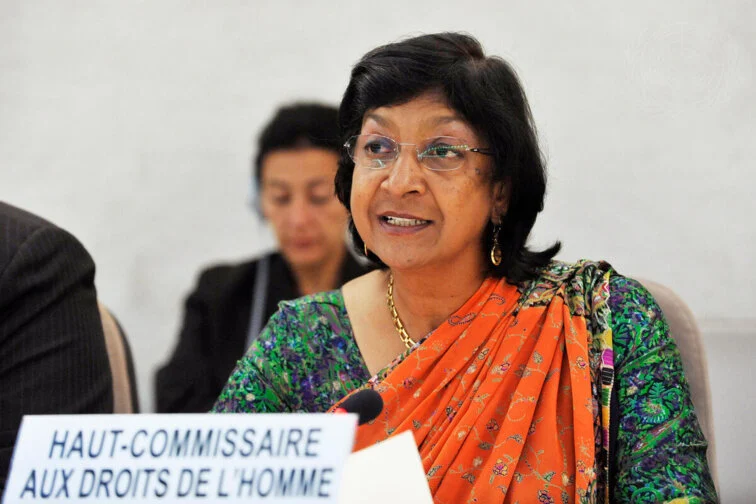
South African jurist Navi Pillay’s Nobel Peace Prize recognises her contribution to international justice. Her career also raises a question for Africa: how will its leaders and institutions uphold the principles she helped advance?
In 1973, Navi Pillay challenged apartheid-era restrictions on political prisoners’ access to legal representation, helping secure rights for detainees on Robben Island, including Nelson Mandela. More than five decades later, the South African jurist has received the 2026 Nobel Peace Prize for her efforts to promote peace and international law.
The Norwegian Nobel Committee recognised Pillay’s contribution to prosecuting war crimes, crimes against humanity and genocide, and said continued attacks on the rule of law and its institutions had shaped its decision. Her career, from apartheid-era courts to international tribunals, reflects a central principle: legal accountability must apply even when those accused hold power.
But her recognition also highlights a dimension of international justice that can be overlooked. African jurists have helped shape the laws and institutions used to address the world’s gravest crimes. The question is whether African states will consistently uphold those principles at home and internationally.
Pillay’s contribution is particularly evident in her work at the International Criminal Tribunal for Rwanda, where she served as a judge from 1995. In the 1998 Akayesu judgment, the tribunal established that rape and sexual violence could constitute acts of genocide when committed with the intent to destroy a protected group. Pillay was one of three judges on the chamber that delivered the landmark ruling.
Prof Ntombizozuko Dyani-Mhango, Professor and Head of the Department of Public Law at the University of Pretoria, said the judgment had “moved conflict-related sexual violence from the margins of international criminal law to its core.”
“I first encountered her jurisprudence through the Akayesu judgment, which became the basis of my LLM mini-dissertation on the status of conflict-related rape in international law,” Dyani-Mhango told TIME Africa.
The ruling went on to shape how sexual violence is prosecuted as genocide, crimes against humanity and war crimes. For Dyani-Mhango, it also informed her doctoral research on whether the African Union has a duty to intervene where such crimes are committed against women in member states.
Her subsequent roles as a judge at the International Criminal Court and United Nations High Commissioner for Human Rights extended her influence across international justice and human rights. From 2021 to 2025, she chaired the UN Independent International Commission of Inquiry on the Occupied Palestinian Territory, including East Jerusalem, and Israel. Since 2019, she has also served as an ad hoc judge at the International Court of Justice, appointed by The Gambia in its case against Myanmar over alleged genocide against the Rohingya.
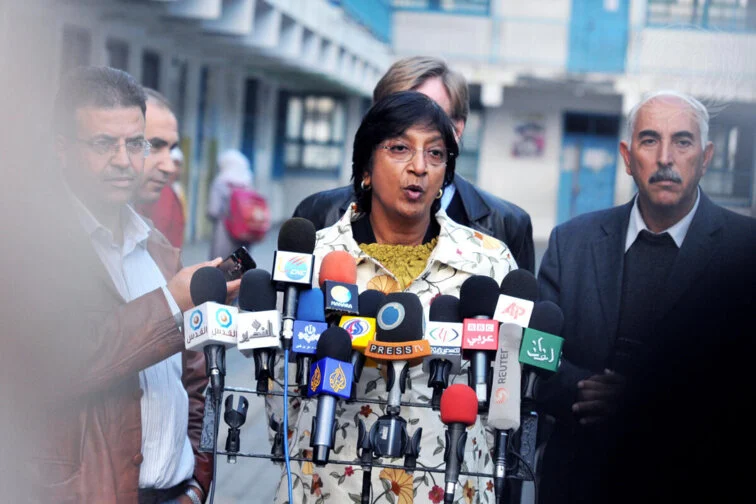
“It is a reminder that Africa is very much part of the conversation,” Ottilia Anna Maunganidze, Head of Special Projects in the Office of the Executive Director at the Institute for Security Studies, told TIME Africa. “Not only as a place where these issues play out, but where African jurists themselves are shaping how we understand human rights and what institutions need to respond to them.”
That contribution does not erase criticism of international criminal justice, including concerns about the International Criminal Court’s concentration of cases in African countries. The Court’s record and the consistency with which international law is applied deserve scrutiny. Several African states have also referred situations within their own territories to the ICC, underscoring that the relationship is more complex than a simple contest between Africa and international institutions.
South Africa’s own history illustrates the tension. In 2016, the government sought to withdraw from the Rome Statute, which established the ICC. The High Court ruled the withdrawal process unconstitutional in 2017, and the government withdrew its notice. Max du Plessis, Senior Counsel in South Africa, barrister at Doughty Street Chambers in London and adjunct professor of international law at the University of Cape Town and Nelson Mandela University, sees Pillay’s approach as rooted in South Africa’s struggle against apartheid.
“Moral leadership, courage, and demanding that the powerful are accountable under law. These are lessons well forged in the struggle against apartheid South Africa,” du Plessis told TIME Africa.
For African governments, the challenge is to defend the fairness and independence of international institutions while accepting that accountability must also apply domestically. Criticising an institution’s shortcomings is compatible with supporting the principles it is meant to uphold.
Pillay’s Nobel Peace Prize recognises a career that has helped shape international legal standards. Its wider significance will depend on what follows. As Dyani-Mhango argues, her example shows “how African jurists and institutions can shape international criminal justice from within, rather than merely receiving norms developed elsewhere.”
For Africa, the task is to turn that contribution into stronger courts and consistent accountability, at home as well as abroad. In 1973, Pillay argued that the law had to reach prisoners the apartheid state had cut off from legal help. Her Nobel Peace Prize honours five decades of holding to it. Upholding that principle now falls to Africa’s governments, courts and citizens.