
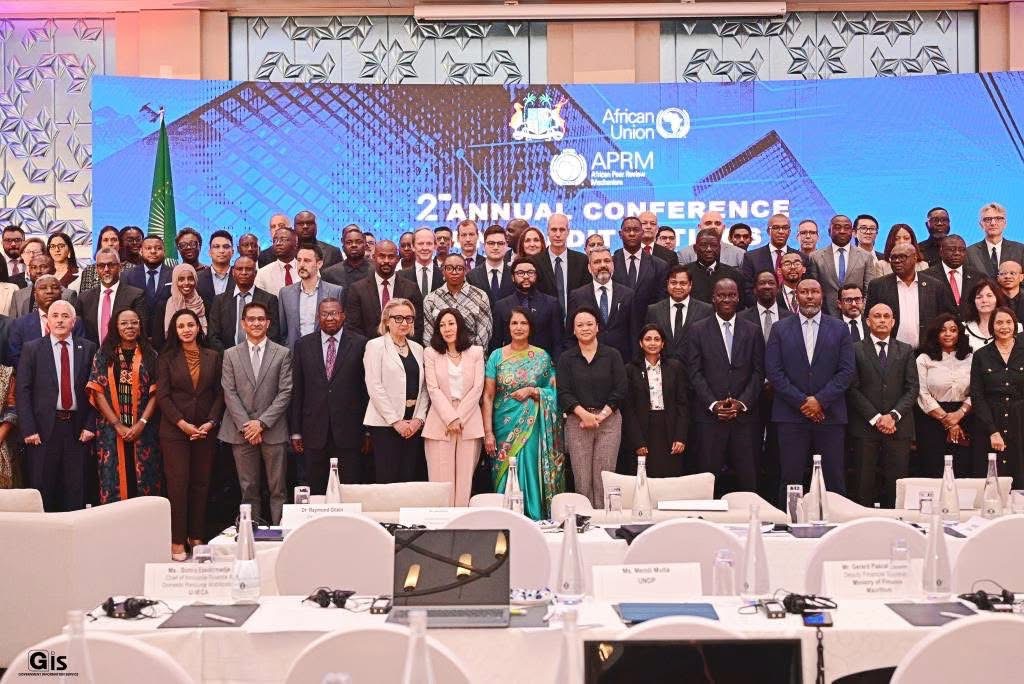
The African regional financial system is moving in leaps and bounds, with milestones and inflection points being reached at an accelerating pace. The second Annual African Conference on Credit Ratings, held in Mauritius under the theme “Towards Developing African Capital Markets: Rechannelling Africa’s Capital”, and the official launch of the pan-African Africa Credit Rating Agency (AfCRA) in Port Louis the following day, are particularly visible steps towards the maturation of the continental financial system.
In 2025, African GDP stood at about USD 2.8 trillion, roughly 2.5% of global GDP, even though the continent is home to almost a fifth of the world’s population. Many commentators believe this underweighting arises from unequal and discriminatory access to the affordable finance needed to fund growth and development.
Because finance is the lubricant of economic development, a financial system that serves development objectives and ambition is an imperative. In recent years, policymakers and practitioners have placed increasing attention on domestic pools of capital, estimated at USD 4.1 trillion and held by commercial banks, insurance companies, pension funds, specialist financial institutions and development banks.
With declining overseas development aid, challenging geopolitical realities and FDI trends that are outside of Africa’s control, there is a greater focus on these domestic pools of capital. In Mauritius, as the policy and specialist community gathered, there were many ideas and solutions coming from multiple directions, all united on the importance of unlocking that capital and putting it to work.
Despite the range of perspectives and diversity of actors, there was considerable agreement that deepening domestic capital markets was the top priority. The banking sector, representing USD 2.3 trillion of the total capital pool, came under particular scrutiny, with the consensus view that the region’s bank assets still reflected underinvestment in productive sectors and processes. Representatives from business associations and Chambers of Commerce lamented the paucity of access to affordable, long-term finance for their members.
The community of practice that gathered in Mauritius wants to put this money to work. Our deliberations were characterised by realism and determination; as one speaker put it, deepening capital markets is a hard slog that will take decades and will be neither automatic nor without pitfalls and periods of backsliding.
This specialist community recognised that economic fundamentals underpin the ability to successfully deepen and expand capital markets and the associated financial ecosystem.
Among the group of distinguished delegates, there was almost consensus that optimism was justified because of the population boom, high GDP growth rates, resource endowments and many examples of success across countries, including the host, Mauritius.
During the two-day conference, only one questioner pushed back, asserting that AfCRA should be neutral and not overly influenced by rising levels of optimism about the region’s prospects. This seems to be an odd position to take, since all risk assessments are subjective, based on one’s epistemic stance and a considered view of future value creation.
Allow me to explain further.
The current dominant culture is based on a framing of economics and finance that sees all actors as concerned with maximising profit over all other objectives. In this neoliberal perspective, countries should give priority to debt servicing above all other uses of government funds.
Credit rating agencies operate within this frame. As a result, sovereigns treat debt repayments and fiscal prudence (read austerity) as priorities, because those that comply are rewarded with upgrades. To the extent that ratings affect borrowing costs, it becomes easier and cheaper for countries to finance debt repayment than to invest in sustainable futures or infrastructure of all kinds.
The notion, then, that financial institutions are neutral is a myth. The prevailing economic system and the values and norms associated with it assert influence on the thinking that shapes the very objectives of credit rating agencies.
Given this, the champions leading this new institution, AfCRA, and all actors that support their efforts, will have to mount a response to these types of challenges; otherwise, credibility will be interpreted as a synonym for status quo maintenance. We must commit to being myth busters and change agents.
To do this we need to reimagine credibility and to do this I offer a more compelling definition of credibility. One that moves credit ratings agencies from living only in the rarified environment of technical specialists elected officials and policy makers, and answers the question – why does this matter and how can it improve the lives of Africans?
This is the question that everyone associated with credit rating agencies should be able to answer, and to craft messages that show a sophisticated understanding. Not only must we have this knowledge, we must also be able to amplify and reinforce the message.
An effective credit rating agency owned, controlled and shaped by Africa can and should be guided by the need to improve how we marshal and allocate collective resources to promote shared prosperity.
Hon. Dr Jyoti Jeetun, Minister of Financial Services and Economic Planning of Mauritius, our host nation, invited the community of practice to move from risk recognition to risk reduction and to facilitating investment at scale.
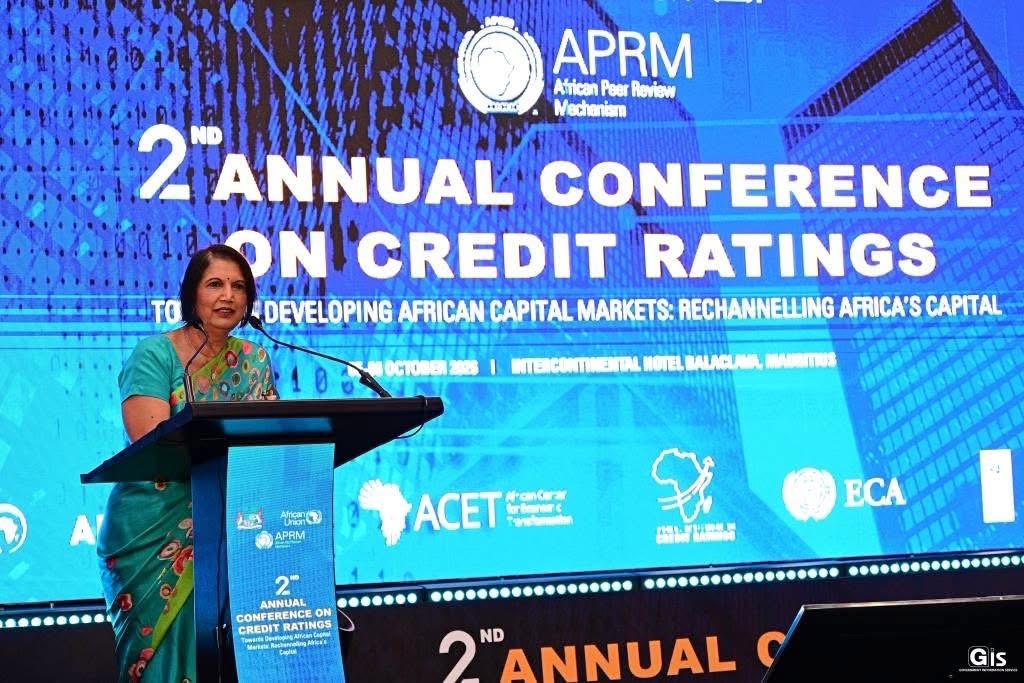
Photo: United Nations in Mauritius and Seychelles/Facebook
Using the domestic financial sector effectively as a lever of transformational change requires intentionality, technical knowledge and expertise, but also a political and conceptual commitment to constructive disruption, conducted not for its own sake, but to effectively change the rules of the game and the wider system in which credit rating agencies operate.
Africa is intervening to change the global financial system because it recognises that the status quo does not serve its citizens. Every high-level diplomatic speaker made this point over three days, and post-launch communications have been just as pointed.
Raising awareness that the current status quo serves to exploit and extract resources from the African region and maintain dependence, including at a psychological level, is often a difficult message to voice. Doing so effectively will require this specialist community of practice to work closely with academics, media and civil society. We must get the narrative right and communicate that these are not bureaucratic, technocratic, self-serving exercises, but important aspects of a development agenda that serves to improve lives and livelihoods and steward the natural environment.
Despite all this commendable effort and a major, historic win, there was a gap in the approach taken in Mauritius, and it is to this point that I turn my attention.
An emancipated approach to financing African development must build on the important work being done by a variety of African institutions and the UN system, but with a grown-up recognition that we must go beyond convening and running initiatives in forms aligned with conventional public policy and diplomacy.
If there is a sense of urgency and a desire to have the private sector and capital markets enrolled as active partners, then the form of engagement must also evolve.
The culture of institutional capital and financial institutions is such that change takes place at a faster pace than in other sectors of society. There is also more of a focus on the risk-return nexus, working directly on high-priority opportunities and delivering results. These aspects of private sector culture must become embedded in our work on deepening capital markets if we are to achieve this mission.
The important work on credit ratings should not be out of step with what is already taking place in African capital markets. This is a time when the Dangote Petroleum Refinery is conducting what is set to be the largest IPO in Africa’s contemporary history, with issuance led by African firms and domestic stock exchanges across the continent. It is an important milestone that has excited citizens on the continent and across the African Diaspora.
The technical experts working on credit ratings, and the high-level political and diplomatic leaders supporting their efforts, ought to absorb some of that action-oriented discipline and attitude, bringing it to bear on their own work. Doing this well requires the niceties of diplomatic protocol to exist alongside private sector culture and ways of working, not overshadow them.
Co-creating an architecture that unlocks trapped capital and puts it to work will not succeed if owners and managers of capital are invited guests rather than architects designing the project alongside policymakers and diplomats. The lost opportunity is that neither side shares knowledge or gains fluency in the other’s vocabulary and routines.
Financial system architectures take a long time to transform, and shifts will be difficult. Earning trust and conferring authority on a new entity will take time and will encounter structural bottlenecks such as inertia and confirmation bias.
Owning and controlling this agenda must mean more than setting up a new agency.
To make this decisive shift, we must place priority on qualitative ways of knowing and describing societal phenomena, so that the formerly accepted positivist philosophies can serve our agenda rather than set it.We must be willing to examine deeply the strategic and collective mission, access to affordable credit, and the role of intermediaries within the system.
This would mean widening our focus beyond access to data and investment in data collection systems, and showing corresponding interest in the underlying assumptions and the processes of interpretation and sense-making that are part of these routines. Surfacing the tacit knowledge, cultural norms and values involved in the conventional rating process is a must.
It appears that the design of AfCRA anticipated that detractors would question its ability to produce professional, evidence-based ratings, with a sophisticated, technology-enabled data collection mechanism and an analytical engine room characterised by openness and transparency. This, even though the three global rating agencies pride themselves on proprietary methodologies that they guard closely. Blunting this double standard upfront was a brilliant stroke. We were invited to participate in AfCRA Live, with the evening’s glitz and glamour turning into a demonstration session. If there were doubts that the pan-African credit rating agency could be operationalised, they were assuaged.
This savvy move by AfCRA must be supported and its intentions protected. When a regional credit rating agency is accused of being less likely to be independent of political pressure, we must ask colleagues in the Global North to examine their own conduct and experiences.
More is needed to open the assumptions driving the analytical engine to interrogation and continuous improvement. It is also important to undertake this as part of an ongoing awareness-raising and education programme that brings about a wider and deeper understanding of the role of financial intermediaries, finance and investment in economic development.
If AfCRA’s analytical engine is better able to take account of the lived realities and structural specificity of African countries, financial institutions and corporates, then its ratings will de facto be an improvement on what currently exists. The leadership of AfCRA understands that there will be unprecedented levels of scrutiny, and should be cautioned that not all offers of assistance and support will be well intentioned.
Institutions like the African Union and parts of the United Nations system, including UNECA and UNDP, have invested considerable political capital in this initiative. The regional development banks and specialist financial institutions, the AfDB and Afreximbank, appear to be onside and aware of the high stakes. When commercial banks, investment banks, transaction advisors, stock exchanges and institutional capital providers are part of this mission and enterprise, it will be that much stronger, more effective and more impactful.
The success of a pan-African credit rating agency and other interventions to shift the global financial system should become a high-priority, shared goal of a collective that spans the entire capital markets universe.
It is at that level of bold, imaginative thinking and doing that we can contribute to making achievement of this venerable goal, improving access to affordable capital, possible.
Aluta continua

Dr. Gillian Marcelle, Chief Executive Officer, leads Resilience Capital Ventures; she has a proven track record in attracting investment and focuses on telecoms, fintech, renewable energy, regenerative agriculture and nature based financing. She has designed architectures that raise capital and facilitate partnerships. In August 2024, she earned recognition as part of the Forbes Fifty Over Fifty | Investment.