
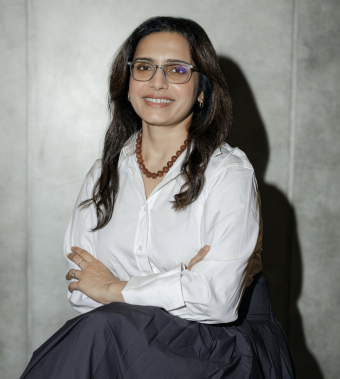
In modern finance, lending and insurance decisions increasingly rely on data-driven models, but those models may not capture every applicant equally. This has been a problem for years, but as AI infrastructure helps industries rethink long-outdated approaches, Pragya Kumar has seen an opportunity to bridge this gap. Kumar is a data science leader and named inventor on multiple U.S. patents, and is working on machine learning systems to support small business lending and insurance access. Her hope is to utilize AI to make these locked-out industries more widely available.
Kumar’s overriding perspective is that financial inclusion is not charity; it is unrealized American economic capacity. Small businesses represent 99.9% of U.S. firms and nearly 89% of recent net job growth, yet fewer than half of those seeking financing receive the full amount. Closing that gap is an underutilized growth strategy, and it is fundamentally a machine learning problem.
Who is Pragya Kumar?
Kumar began by earning a Master’s degree in Industrial Engineering and Operations Research from the University of California, Berkeley. Through this education, she was exposed early on to the mathematics of scarce resources and imperfect information.
However, her first work in applied machine learning actually had nothing to do with finance. Kumar built predictive systems for the food supply chain: sensor networks inside grain storage facilities and feeding models that could forecast spoilage. The problem she was solving was unglamorous but had a significant cultural footprint, as a meaningful share of the world’s harvested grain was being lost after harvest. This was not for lack of food but for lack of visibility.
Kumar’s work in this sector has produced granted U.S. patents on machine learning and anomaly detection applied to remote sensing and predictive quality management.
Today, she leads data science for small business and insurance products, building the machine learning systems that may determine whether a small business owner can access capital, and whether an individual or family can obtain insurance coverage they can actually afford. As Kumar says, “It is the same problem I started with, moved from silos to households.”
The Inspiration Behind the Inventions
Kumar’s realization about the financial industry was simple, but it has powered everything she has done since. “The moment it clicked for me was realizing that in modern financial services, the risk model is the gatekeeper. Not the loan officer, not the branch, not the policy: the model. If the model cannot see you, the system cannot serve you. And a very large number of Americans are, in a statistical sense, invisible,” she said.
The Federal Deposit Insurance Corporation’s (FDIC) most recent national survey found that 4.2% of U.S. households were unbanked and another 14.2%, which translates to roughly 19 million households in total, were underbanked, holding an account but still relying on nonbank products to meet basic financial needs.
Insurance is the quietest version of the same failure. LIMRA’s 2025 research puts roughly 100 million Americans in the gap: people who need life coverage or need more of it than they carry. Insurance is the instrument that could keep one bad month from becoming generational poverty, and a hundred million people are standing outside it.
“The moment it clicked for me was realizing that in modern financial services, the risk model is the gatekeeper.”
As Kumar explains, “I did not come to this work as an activist. I came to it as an engineer who noticed that the constraint was mathematical, and therefore solvable. If someone is denied because a model cannot read them, that is not a moral fact about the applicant. It is an unsolved inference problem. That is the work.”
Final Thoughts
Moving forward, Pragya Kumar is passionate about helping forge a better future by implementing new systems and AI technologies in bold ways. In five years, her hope is that inclusive underwriting is unremarkable and has instead become the default engineering standard.
Kumar’s aspirations include continuing to lead data science organizations building AI systems that expand access to capital and coverage at national scale. She also hopes to continue contributing original, patented methods to the field. Through these measures, she plans to build better systems that actually help modern Americans in palpable ways.
The information provided in this article is for general informational and educational purposes only. It is not intended as legal, financial, medical, or professional advice. Readers should not rely solely on the content of this article and are encouraged to seek professional advice tailored to their specific circumstances. We disclaim any liability for any loss or damage arising directly or indirectly from the use of, or reliance on, the information presented.
TIME Africa staff were not involved in the creation of this content.