
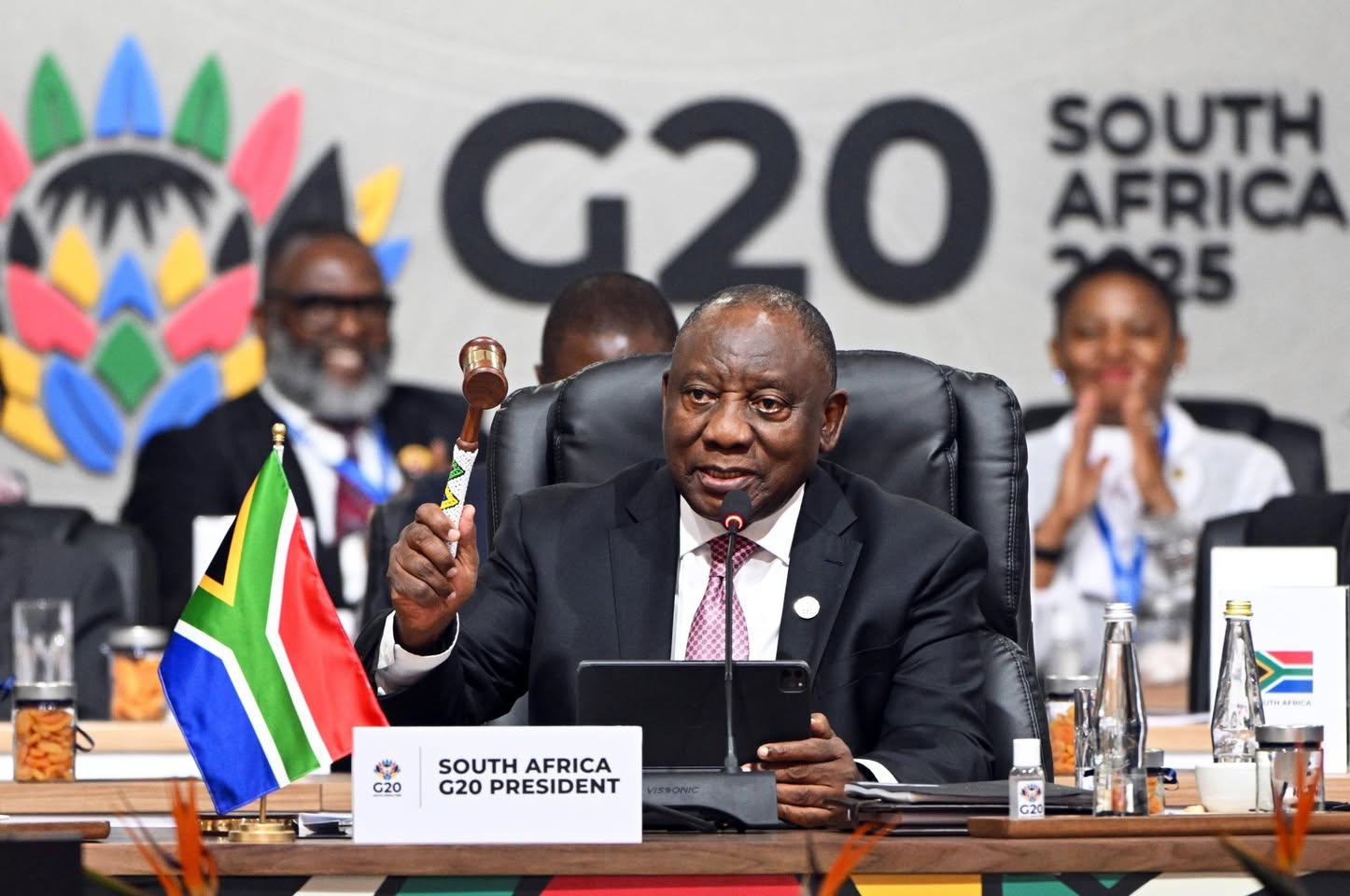
As the sun set over Johannesburg’s Sandton Convention Centre, the historic G20 Summit of 2025 drew to a close. For the first time, this influential forum gathered on African soil, signalling a significant milestone in global governance. The summit was more than a routine gathering of world leaders; it was a profound test of the multilateral system, made all the more significant by the African Union’s recent integration as a permanent member.
The world watched as leaders tackled a formidable agenda set against a backdrop of geopolitical tensions, an accelerating climate crisis, and a global debt problem threatening growth in the Global South. The central question was whether South Africa, as host, could bridge the deep divides between established Western powers and the burgeoning BRICS+ alliance.
The second and final day of the summit provided a clear, albeit complex, answer. While deep-seated disagreements were not entirely resolved, the outcomes detailed in the “Johannesburg Declaration” signalled a significant shift toward the priorities of the developing world. From significant commitments on climate finance to rewriting the rules of the global economy, the Johannesburg Summit delivered a roadmap that is both pragmatic and transformative.
South Africa’s Landmark G20 Presidency
President Cyril Ramaphosa’s administration made a bold statement by centering the summit on the theme of “Solidarity, Equality, and Sustainability.” This was a deliberate departure from previous G20 hosts, who often prioritized stability and the status quo. Instead, South Africa championed a development-focused agenda, using its unique position to steer conversations away from polarizing conflicts and toward shared existential threats: poverty, inequality, and climate change.
Pretoria’s diplomats skillfully kept the world’s attention focused on finding common ground. By positioning itself as a bridge-builder, South Africa demonstrated that African leadership is not merely about participation—it is about setting the agenda. The successful execution of the summit also served as a soft-power victory, showcasing the continent’s capacity to host high-stakes global forums with precision and purpose.
Major Global Agreements Reached
The second day of the summit saw world leaders finalize several critical agreements. The negotiations, which ran late into the night, produced consensus on economic policy, climate change, pandemic preparedness, and trade.
Economic Cooperation
A central achievement was the renewed commitment to multilateral economic cooperation. Leaders agreed to coordinate fiscal and monetary policies to combat global inflation without stifling growth. Leaders highlighted the importance of reinforcing the global financial safety net, agreeing to boost the lending power of the International Monetary Fund (IMF) and other major development banks to better support countries in need. A key breakthrough was the agreement on a new framework for sovereign debt restructuring, designed to provide faster and more comprehensive relief for low-income countries facing debt distress.
Climate & Energy Outcomes
Climate and energy discussions were among the most contentious, but the final day brought significant progress.G20 leaders reiterated their support for the Paris Agreement and pledged to speed up the shift toward clean and sustainable energy sources. A landmark deal was struck to create a “Global Green Transition Fund,” aimed at mobilizing private and public capital to support renewable energy projects in developing nations. While debates over the timeline for phasing out fossil fuels were intense, the final text calls for a “rapid and just transition away from unabated fossil fuels,” marking a notable step forward in global climate ambitions.
Global Health & Pandemic Readiness
Drawing lessons from the COVID-19 pandemic, the G20 established a new “Global Health Security Pact.” This pact aims to strengthen pandemic prevention, preparedness, and response capabilities worldwide. Key provisions include increased funding for the World Health Organization (WHO), a commitment to equitable access to vaccines and medical treatments, and a framework for sharing public health data more effectively during global health emergencies. The agreement signals a unified recognition that global health is a collective responsibility.
Trade & Supply Chain Security
In response to recent disruptions, leaders endorsed a plan to enhance the resilience of global supply chains. The agreement promotes diversification, transparency, and the digitalization of trade processes. It also includes a pledge to resist protectionist measures and uphold the principles of the World Trade Organization (CEO). The focus was on creating more robust and flexible supply networks that can withstand future shocks, ensuring the stable flow of essential goods across the globe.
Africa-Specific Wins
The Johannesburg summit marked a defining turning point for the African continent. South Africa’s presidency ensured that Africa’s voice was not just heard but acted upon, resulting in several key victories:
- Infrastructure Investment: The G20 launched the “Partnership for African Infrastructure,” a multi-billion-dollar initiative to fund critical projects in transport, energy, and digital connectivity across the continent. This is seen as a direct response to Africa’s massive infrastructure gap.
- Food Security: A new program was established to support sustainable agriculture and food systems in Africa, aiming to reduce the continent’s reliance on food imports and bolster its resilience to climate-related food shocks.
- Digital Transformation: Leaders are committed to supporting Africa’s digital transformation by investing in digital literacy programs and expanding internet access, recognizing the digital economy’s potential to drive growth and create jobs.
- Representation in Global Institutions: The final communiqué included a strong call for reforming global financial institutions to give African nations a greater voice in decision-making processes, a long-standing demand of the continent’s leaders.
- Peace, Stability: The Johannesburg Declaration directly addressed several challenging geopolitical issues without hesitation. While carefully navigating contentious topics, it reinforced a collective commitment to pursuing global peace and stability through multilateral cooperation.
Controversial Moments & Global Reactions
Despite the progress, the summit was not without sharp discord. The drafting of the paragraphs relating to geopolitical conflicts nearly derailed the entire communiqué. Western nations pushed for strong condemnation of specific aggressor states, while several BRICS nations advocated for neutral language focused on “peacebuilding.”
A visible rift emerged during the plenary session on carbon border taxes. Several emerging economies accused the European Union and the United States of “green protectionism,” arguing that carbon tariffs unfairly penalize developing nations. While the final text acknowledged these concerns, it stopped short of suspending the tariffs, leaving this as a brewing trade war for the future.
Protests outside the Sandton Convention Centre also highlighted the disconnect between high-level diplomacy and grassroots reality. Civil society groups criticized the G20 for not going far enough on debt cancellation, arguing that the reforms are merely “rearranging the deckchairs on a sinking ship.”
Key Speeches That Shaped the Summit
Two speeches defined the emotional and intellectual arc of the summit.
President Ramaphosa’s opening address on Day Two was a masterclass in assertive diplomacy. He stated, ” We have met this year in the face of significant challenges, and demonstrated our ability to come together even in times of great difficulty to pursue a better world.” He also said that “Together, we can ensure that no one is left behind.”
Conversely, EU Commission President Ursula von der Leyen and Council President Antonio Costa. In her speech, von der Leyen at the G20 Session stressed the importance of the summit, calling for “inclusive and sustainable economic growth that leaves no one behind.”
“Addressing global imbalances requires coordinated and cooperative action: With the help of our international institutions, the IMF, the WTO, and the World Bank, we should have a genuine assessment of global imbalances where root causes are discussed,” said Von der Leyen.
“Europe needs to shoulder its responsibilities and boost investment, but I repeat, this is a collective responsibility,” she added.
What These Outcomes Mean for the Future of Africa
As the G20 presidency prepares to rotate to the United States for 2026, the legacy of the South Africa summit will be measured by implementation.
The outcomes of Johannesburg 2025 signal that the “African Century” is no longer a slogan—it is a geopolitical structural reality. The Global South has successfully demonstrated that it can lead, negotiate, and secure outcomes that benefit the majority of the world’s population.
However, the danger lies in inertia. The promises made in Sandton regarding climate finance and debt relief are voluntary commitments, not binding laws. The challenge for the African Union and its allies will be to hold the G20 accountable in the months and years ahead.
For now, South Africa has proven that Johannesburg is not just a financial hub but a global diplomatic capital. The 2025 Summit did not solve every problem, but it successfully shifted the center of gravity. The world came to Africa, and for the first time, Africa set the agenda.
Here is a recap of what happened in Day One of the G20 Summit: Read Recap Article Here