
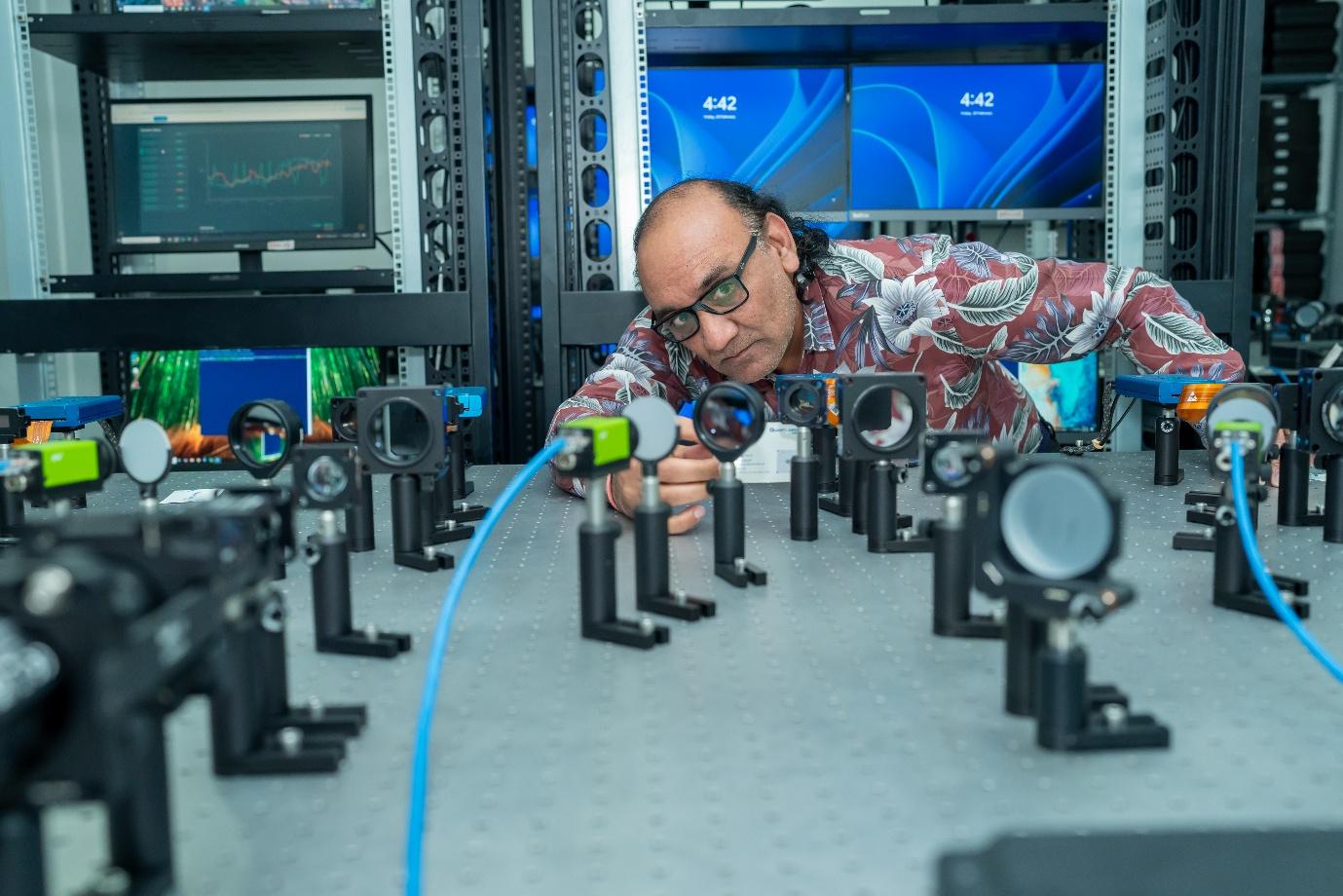
The world, especially over the last decade, has seen significant exploration of scientific ideas, breakthroughs in the tech space, and visionary thinking. All this has helped in shaping the next era of intelligence systems. People around the globe have also held meaningful conversations about artificial intelligence (AI), largely focusing on software models, cloud infrastructure, and powerful electronic chips. However, many researchers and thought leaders in the photonic intelligence realm may question, ‘What if the next leap in intelligence doesn’t come from faster code, but from a new medium of computation itself?’ This question now guides a new frontier called photonic intelligence, a field where light, rather than electricity alone, becomes the carrier of information and computation. Dr. Pramod Kumar is a prominent figure in the quantum photonics realm who has been helping to frame this transition through his unique Abu Dhabi-based QuantLase Research & Development Centre (QRDC).
Also known as the Quantum Seeker, Dr. Pramod Kumar’s recent work has drawn attention to the possibility that intelligence may be less about programming and more about unlocking patterns already present in nature. As he explains, “Intelligence is not created; it already exists as a continuous field in nature. What we call brilliance is simply the ability of a system to capture and express it. At QRDC, through photonic intelligence, we are not programming machines to think; we are enabling light itself to reveal the answers.” This explains how intelligence isn’t just a software output but also an interaction between physics, architecture, and information flow.
Understanding Photonic Intelligence
First, it is essential to dig a little deeper into photonic intelligence. It refers to computing systems that use photons (light particles) instead of electrons for critical computational tasks. The conventional processors move electrical signals through transistors. Photonic systems use beams of light passing through optical structures, waveguides, and interferometric circuits. This matters because light-based systems may offer practical advantages over conventional electronic processing. Light can move quickly, generate less heat in certain architectures, and support parallel processing. For machine learning workloads, especially matrix multiplication, which supports many neural networks, these qualities may help reduce latency, improve parallelism, lower energy demands, limit thermal constraints, and support higher data throughput.
When Physics Becomes Part of the Computation
One of the most compelling ideas emerging from this field is that physical systems themselves can compute. Instead of forcing every problem through sequential digital instructions, optical systems can naturally explore many probability states at once. Dr. Pramod Kumar has described intelligence as something that may exist within broader patterns of possibility, rather than only within programmed systems. In that view, photonic architecture becomes one way to organize and express those possibilities through engineered systems. This also explains a growing academic trend of using natural phenomena such as light, interference, phase modulation, and entropy as computational resources. It also suggests that future computing may rely not only on logic gates, but also on the laws of physics themselves.
From Optical Theory to Real-World Systems
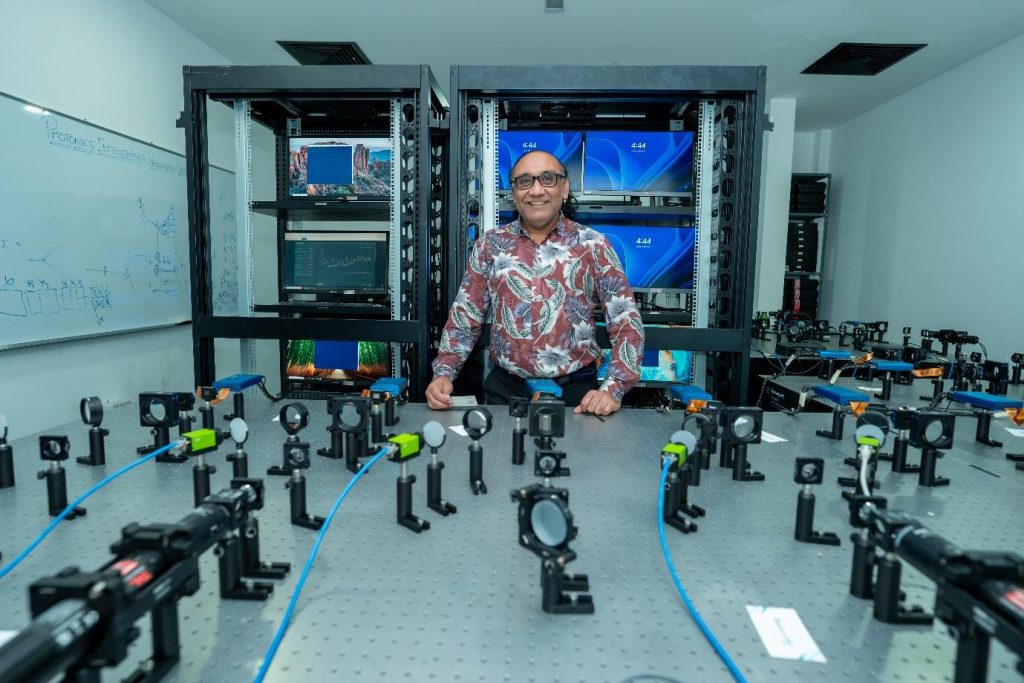
Translating optical theory into deployable hardware requires expertise across multiple disciplines, including signal processing, semiconductor fabrication, optical chip design, materials science, thermal and manufacturing validation, and AI systems integration. Under the leadership of Dr. Kumar, researchers at QRDC have been developing systems designed to integrate photonic chips and intelligent processing architectures for real-world use. One emerging idea associated with this movement is the Photonic Intelligence Processing Unit (PIPU), a model for converting distributed optical possibilities into deterministic outcomes. Dr. Kumar describes PIPU as a model for using photonic hardware to organize light-based information and translate complex optical patterns into more defined computational outcomes.
A Different Framework for Future Computing
It is essential to understand that the rise of photonic intelligence isn’t just about building faster chips; it also shapes how society may think about intelligence itself. Photonic intelligence today represents a new foundation in which light serves as both messenger and processor. Dr. Pramod Kumar suggests that future advances in computing may rely more heavily on light-based systems alongside, or in place of, traditional electronic processing.
TIME Africa staff were not involved in the creation of this content.