

Four hundred years after enslaved Africans were forced from Ghana’s shores to Caribbean plantations, one of Africa’s most powerful kings made the reverse journey. This time, he came as an honoured guest to talk business and reconnect with the diaspora.
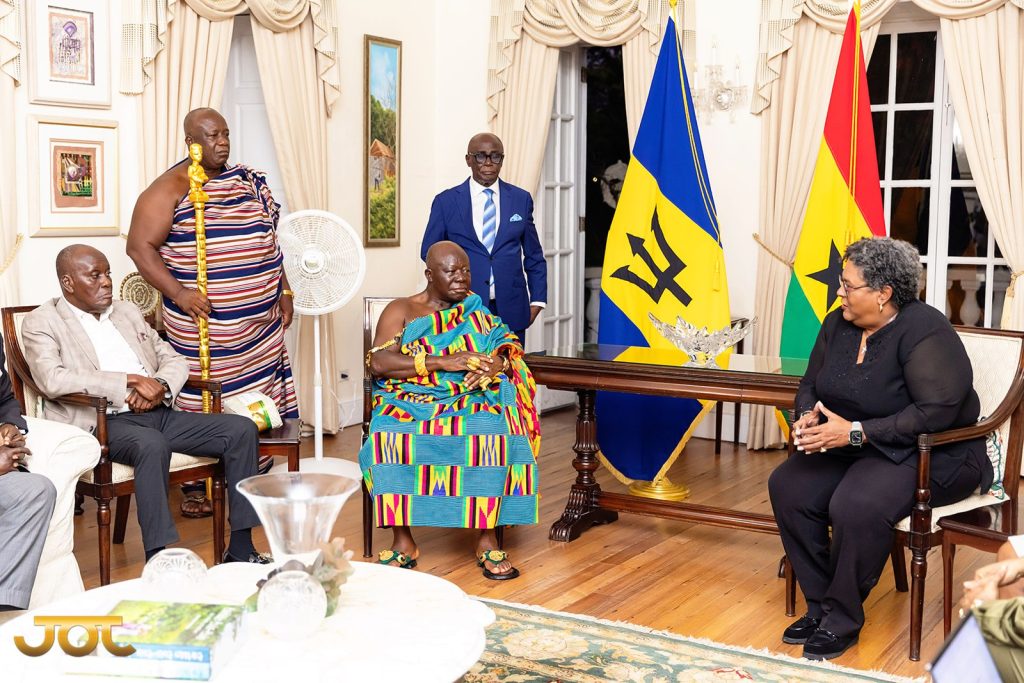
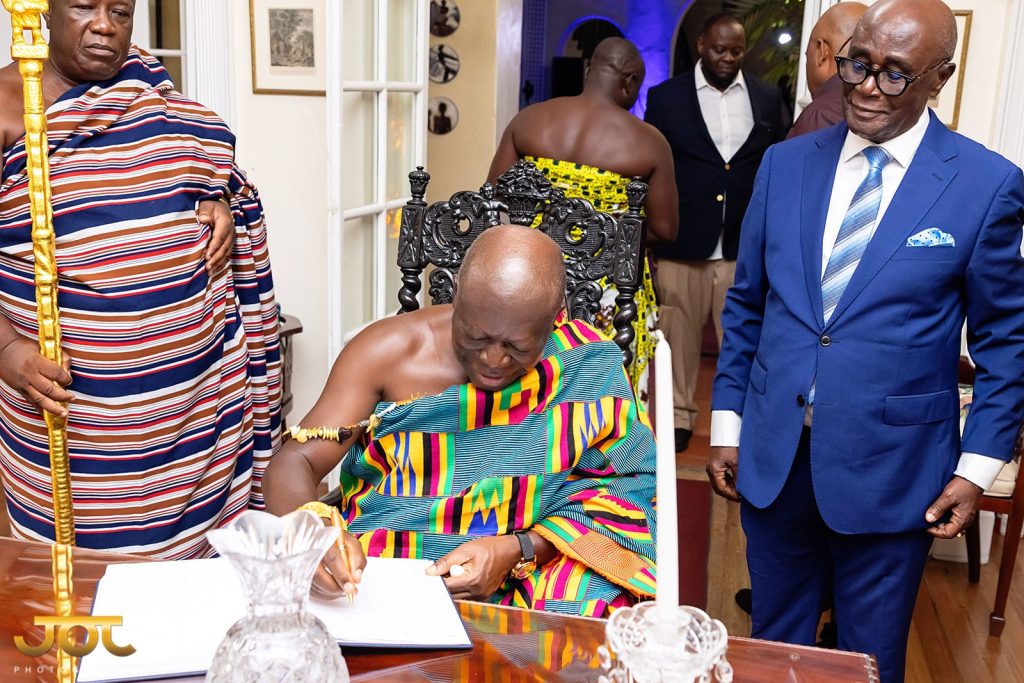
When the Asantehene of Ghana, His Royal Majesty Otumfuo Osei Tutu II, touched down in Barbados on November 11, the moment was not mere symbolism. It coincided with the arrival of the first private-sector charter flight connecting Accra to the Caribbean on a journey that reversed centuries of separation between Africa and the Caribbean.
The historic flight, sponsored by Milvest, part of Miller Holding, the title sponsor of the GUBA Trade and Investment Conference & Awards 2025, transported business leaders, investors, and cultural figures.
A private reception at Prime Minister Mia Mottley’s residence underscored the highest levels of government engagement. But this time, the agenda wasn’t charity or historical grievance, it was business.
“This is about rebuilding the bridges that slavery and colonialism tried to destroy,” said Lady Dentaa Amoateng MBE, Founder of GUBA Enterprise, which organized the three-day GUBA Trade and Investment Conference.
From Chains to Contracts
Between the 16th and 19th centuries, over 400,000 enslaved Africans passed through Barbados alone, according to Library of Congress documents. The island became one of Britain’s most profitable colonial possessions, built on the brutal labour of people torn from West Africa’s Gold Coast, now present-day Ghana.
The Asante Kingdom, one of West Africa’s most sophisticated civilisations, witnessed this extraction firsthand. While the kingdom resisted European colonisation until the late 19th century, the broader Gold Coast region became central to the slave trade, with coastal forts serving as holding pens before the Middle Passage.
This November, as the Asantehene’s convoy rolled through Bridgetown streets, that history provided context for a radically different kind of Atlantic crossing.
Why the Private Sector Is Leading
The absence of commercial flights between Africa and the Caribbean has long symbolized a deeper disconnection. Despite shared history, culture, and economic potential, the two regions remain largely isolated from each other in trade and investment.
Milvest’s sponsorship represents a crucial shift in Africa-Caribbean partnerships. Rather than relying solely on government agreements or international development agencies that have produced limited results in the past, private companies are building bridges.
“Today, there are no commercial flights linking Africa and the Caribbean,” said Turhan Mildon, CEO and Chairman of Miller Holdings and Milvest. “Yet our shared history, culture and aspirations call for stronger ties. Through this initiative, we wanted to demonstrate that such a connection is not only possible but within our reach.”
Previous pan-African unity initiatives have faltered on implementation.
This time, organizers argue, is different precisely because the private sector, not governments, is driving the agenda. As African nations diversify trade beyond traditional Western markets and Caribbean economies seek alternatives to tourism dependence, the Africa-Caribbean corridor represents untapped potential.
The African Continental Free Trade Area, operational since 2021, has created new frameworks for exactly this kind of South-South cooperation. The question is whether political will and private capital can finally align.
From Rhetoric to Results
The November 10-12 conference delivered concrete outcomes. Barbados became the first Caribbean nation onboarded to the Connecting One Million Women in Trade network (C1WT), an initiative aimed at closing the gender gap in global commerce through capacity building and trade facilitation.
Most significantly, the Barbados Chamber of Commerce and Industry and Ghana National Chamber of Commerce and Industry signed a Memorandum of Understanding, three years in the making, to formalize business partnerships and advocate for regular direct flights between the two nations.
“This is a meaningful step from symbolism to structure,” said Ambassador Juliette Bynoe-Sutherland, who championed the agreement. “Engaging the private sector through Chambers of Commerce provides a mature platform for businesses seeking to access new markets.”
The attendance of Barbados President Dame Sandra Mason and Grenada Prime Minister Dickon Mitchell elevated the event beyond an awards ceremony into economic diplomacy.
Culture as Economic Strategy
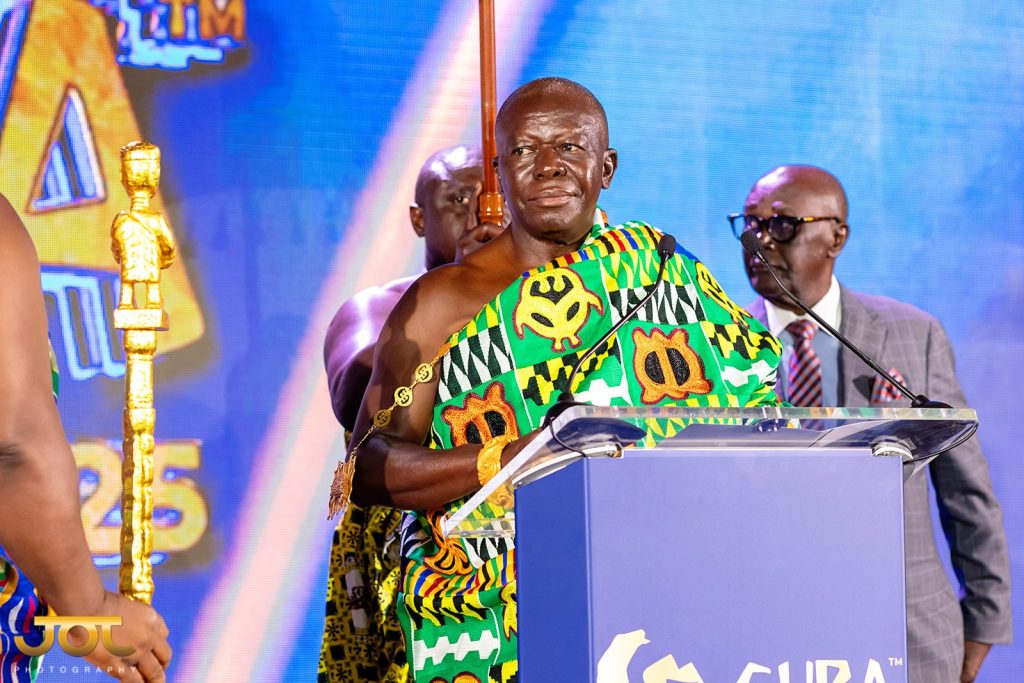
At Wednesday’s gala, the Asantehene addressed attendees in traditional kente cloth, his message unmistakable: reconnection must be economic, not merely sentimental.
“The diaspora is certainly crucial in shifting the global narrative about Africa from one of dependence to one of opportunity, partnership and strength,” he declared. He encouraged the diasporic community to “join their brothers and sisters in Africa and take ownership of the products of their creative talents and abilities.”
The awards ceremony showcased this vision in action. Central Bank of Barbados Governor Dr Kevin Greenidge received recognition for economic leadership. Dr Velma Scantlebury, the first Black female transplant surgeon in the United States and a Barbados native, was honoured for transformational impact in medicine—a reminder that diaspora excellence spans continents.
Cultural exchanges also carried commercial weight.
Ghanaian designer Grace Yeboah Ofori showcased her luxury brand TruFaceByGrace, whose designs have been worn by Janet Jackson, drawing investor interest in African fashion’s growing market.
Nigerian filmmaker Tola Odunsi premiered his cybercrime thriller “19,” sparking discussions with Barbados education and culture ministers about Nollywood-Caribbean collaboration.
These aren’t just feel-good cultural exchanges. Nollywood generates over $600 million annually, while African fashion exports are projected to reach $15.5 billion by 2025, according to UNESCO.
Cultural products represent genuine trade opportunities.
The Test Ahead
The chartered flight showed that Africa-Caribbean links are possible, though profitability is still unproven. One strong conference is not enough. Infrastructure gaps must be fixed, routes must make financial sense, and investment promises must turn into real capital.
The real test will show up on the balance sheets of November 2026. Can diaspora networks sustain investment? Can tourism and cultural partnerships produce jobs and growth? The answers remain to be seen. But as delegates left Barbados with new agreements, the resolve was clear. Africa and its diaspora want to define their own terms.
“We witnessed the rewriting of a narrative,” Amoateng said. “For 400 years, the Atlantic meant separation and trauma. This week, it meant reunion, healing, and economic empowerment,” she added.