
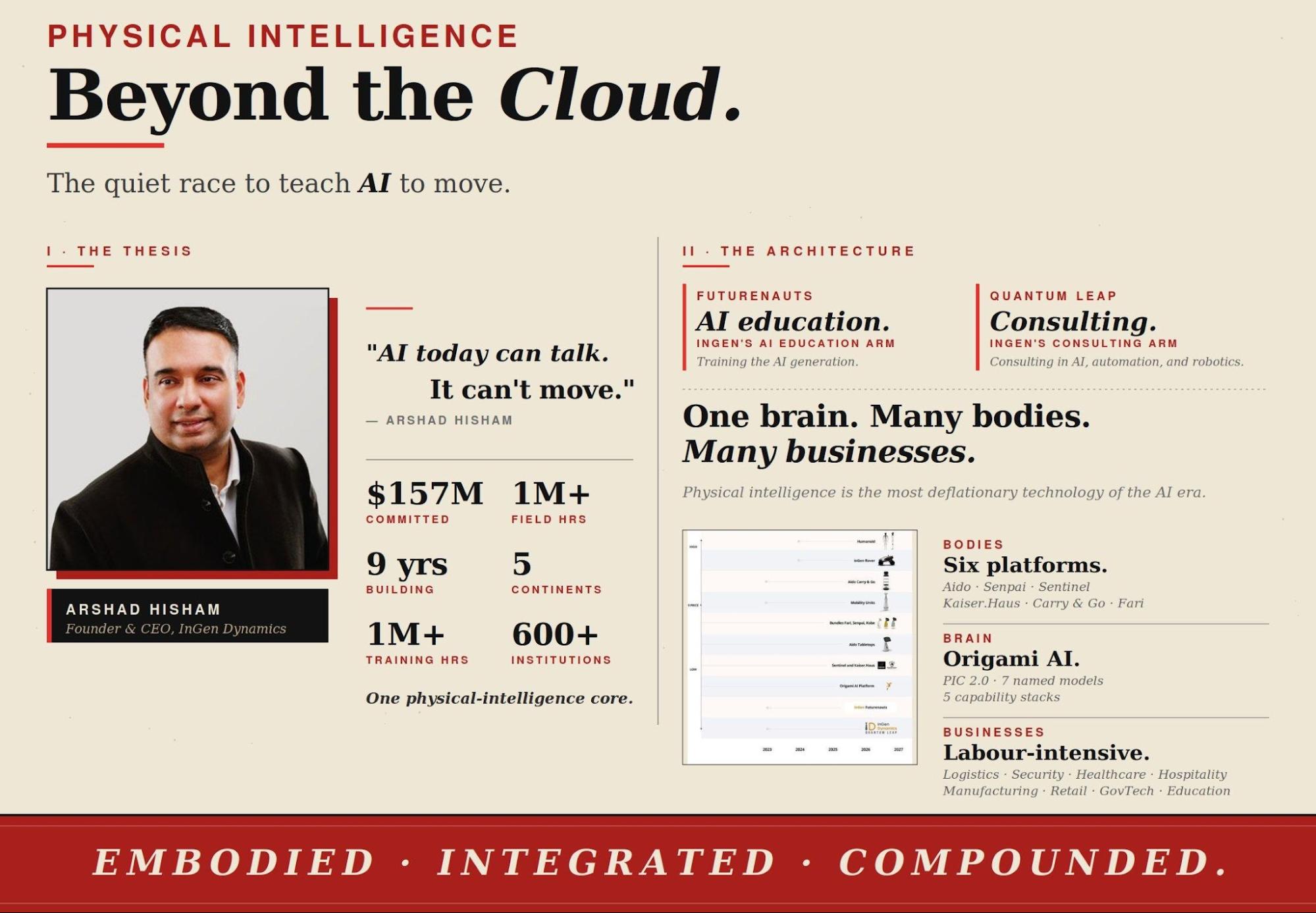
While the world debates on chatbots, some technologists, notably Arshad Hisham, are building physical intelligence, which is AI that can perceive, reason, and act in the real world. He has spent nine years assembling the pieces across five continents.
AI conversations have mostly focused on chatbots and browser tools. But places like hospitals and schools still depend on people and outdated systems. That gap highlights the difference between what AI can say and what it can actually do.
Arshad Hisham, who splits his time between London, New York, Bangalore, Dubai, and Santa Clara, has framed the problem like this: “AI today can talk. It can’t move.” His company, InGen Dynamics, an Edison Award Silver Medalist, has spent years building what is called physical intelligence, or the application layer of AI for the real world.
This autumn, Hisham’s positioning and credibility among robotics and capital markets, hardware and education, and regulation and research were acknowledged by the U.S. His This autumn, Hisham’s positioning and credibility among robotics and capital markets, hardware and education, and regulation and research were acknowledged by the U.S. Secretary of Commerce and the UK Secretary of State. He received a private invitation to the US Business Reception at Lancaster House in London during the Presidential State Visit, the diplomatic showcase of the US–UK Economic Prosperity Deal. Futurenauts initiative was highlighted by the UK Prime Minister’s Office in an official No. 10 Downing Street statement on the UK–India trade mission, which recorded AH Gamma’s commitment to invest £8 million in the UK and create 30 new jobs delivering AI, robotics, and automation education.
For most of his career, Hisham has operated in the space between industries that don’t usually speak to each other — robotics and capital markets, hardware and education, regulation and research. The Futurenauts curriculum work also runs alongside his active initiatives.
The architecture problem
Industrial robots are precise, but they are also, as some people building next-generation systems describe them, limited to predefined tasks. Take, for example, an orange-cased robotic arm in a factory. It knows its task, but moving the location and changing the task makes it halt.
They are also costly. Physical intelligence wants to change this.
Consider this: Build the brain once. Run it across many bodies, many tasks, many environments. Let it learn from the entire fleet as it goes.
Practitioners describe it as one brain, many bodies. A single hardware-agnostic, edge-native, multimodal AI layer is built once and then deployed across different physical forms. For example, a hospital service robot, a security sentinel, and eventually a humanoid.
Who is building it
Multiple big companies are betting on a humanoid that walks and picks like a person, and eventually replaces a person. Some are focusing on logistics, and others on motion engineering.
Another group is taking a different route. Application-layer companies are picking the commercially ready industries (eldercare, security, delivery, education) and applying the one brain, many bodies principle across them.
InGen Dynamics, founded in 2015 and Silicon Valley-headquartered, is among the companies operating down this lane. The company calls its intelligence layer the Physical Intelligence Core (PIC 2.0), branded externally as Origami AI.
It is mainly composed of six commercial platforms sharing a single brain, namely Aido (a service robot), Senpai (an educational companion), Sentinel (an enterprise-security system), KAISER.HAUS (a smart-home layer), Carry & Go (an autonomous indoor delivery unit), and Fari (an eldercare companion).
Looking ahead
InGen Dynamics has a hybrid DNA shaped by the founder’s experience in enterprise software, supply chains, and hardware. Arshad Hisham was born in Kerala and started his first venture at age ten. Before founding InGen Dynamics, he launched four startups between 2008 and 2015. Today, he works as an executive, engineer, educator, inventor, founder, CEO, board member, investor, and author.
He has created three book-length projects, namely, the 2035 Series, AI Culture Shift, and The Last Debate, and has been cited by MIT. He has also spoken at the IEEE Robotics Summit at Columbia. The BCG AI Summit in Chicago. Walt Disney Imagineering in Glendale. TEDx Doha. The AT&T Global CEO Advisory Council in Dallas. The 92Y City of Tomorrow Summit in New York. A Volvo Group digital summit in Bangalore alongside NVIDIA’s South Asia leadership. Coverage in IEEE and ASME proceedings, Popular Science, Discovery Channel.
The ledger
The case for physical intelligence is largely driven by demographics. Labour shortages in Japan, Germany, Italy, South Korea, and the UK’s NHS are increasing demand, while India and much of the Global South are industrialising faster than skilled workers can keep up.
Analysts increasingly view embodied AI as a major long-term market opportunity, with projections suggesting substantial growth over the coming decades. Per the WEF Future of Jobs Report 2025, 170 million new roles will be created and 92 million displaced by 2030 (net +78 million), driven primarily by AI and information processing. A 2026 DataCamp–YouGov survey reports a 59% AI skills gap.
Investors are betting that a few companies could become the main platform behind large-scale physical automation.
InGen Dynamics offers a concrete window into what that looks like at the operating level of one such platform. The company has publicly reported $157 million in aggregate funding commitments, a commercial pipeline of $80 million in identified opportunities, and cumulative deployment across the United States, the United Kingdom and Asia-Pacific of more than one million field-operation hours.
The company reports having reached these milestones on under $7 million of operating capital. By robotics standards, that is a level of capital efficiency with few parallels.
The adoption problem and Futurenauts
Operators, regulators and the public don’t adopt systems they don’t understand. In hospitals, warehouses, and classrooms, robots need to feel legible to the people working alongside them, because if not, they stop being deployed.
Hence, education, in this category, is an engineering function.
InGen is the most developed example. Futurenauts, Hisham’s education project, built on the same Origami AI intelligence layer as the commercial robots, spans more than 600 institutional relationships across five continents. Its reach spans K–12 classrooms, university partnerships, and student engagement programs across multiple regions, including the GCC, South Asia, the UK, North America, and India. This includes work with school-age learners, higher education institutions, and university students through a range of academic, innovation-focused, and future-readiness initiatives.
Hisham describes: “We built Futurenauts not because there was a gap in the EdTech market, but because there was a structural failure in how the world values human capability.”
The claim reflects how automation and education are not two industries. They are two sides of the same problem. Every automated task reshapes the skills people need next. Without systems to develop those skills, the gains from physical AI become harder to sustain.
The first beachheads
Physical intelligence’s most credible reading can be observed in labour-heavy services, such as facilities management, security, cleaning, etc.
Three structural traits make this category uniquely receptive to a shared intelligence layer. Labour represents the dominant share of revenue, so AI compression may translate into margin. Work happens at thousands of fragmented sites, so centralised intelligence is structurally valuable. And contracts are recurring SLAs, so operational improvements compound across the relationship rather than dissipate at renewal.
Accordingly, large global service companies are building their own AI platforms. The race is between AI-native platforms extending into services operations, and legacy services giants acquiring or building the AI capabilities that compress their cost base.
With both routes leading to similar destinations, the crown is for the route that assembles the assets faster and integrates them to the depth the platform thesis actually demands.
InGen Dynamics is now participating in this convergence with its “Many bodies, many businesses” extension.
Many bodies, many businesses
Once an intelligence layer can run across different machines, the next step is to use it across service businesses that manage workers, customers, and operational data. InGen Dynamics is pursuing this through labour-intensive business acquisitions connected to its Origami AI platform (plus six commercial robots and the seven-model AI stack).
Each acquisition adds more data, more robot deployment sites, and more customers. More sites create more telemetry, which may help improve the AI core and support future deployments.
The model grows faster because of the ecosystem built around it.
Most rollup acquisitions fail during workforce integration because payrolls, training systems, and career structures do not match. InGen Dynamics’ Futurenauts and a Global Skills Passport (which tracks eight capability areas) create a shared workforce system where employees can move across acquired companies under one standard.
InGen also uses Quantum Leap, its AI and digital-transformation consulting arm, to complete integration within 90 days by combining technology, workforce systems, and operations in one process.
Unlike competitors selling humanoids, vision systems, or AI models to operators, InGen extends its platform into the operating businesses themselves. This lets the company control both the AI layer and operating revenue, though it requires more capital than a pure-tech model. Real-world operations also generate training data, which may help strengthen workforce systems, speed up future integrations, and grow the business alongside the technology.
The strategy still carries risks. Services rollups are difficult, integration capacity is limited, and regulations vary by region. Even so, the model is well-suited to a market now favouring proven operations over prototype demos.
The open questions
Three tests will decide which companies survive this decade.
Does the architecture generalise? Companies with one shared intelligence layer could potentially scale more efficiently, while others may stay limited and expensive.
Does adoption scale past the pilot? Many robotics projects never reach long-term contracts.
Do policy and public trust keep pace? Even strong technology can fail if people reject it (as history shows).
These questions are being answered by companies working on humanoids, logistics, infrastructure, and AI foundation models. InGen Dynamics is betting that one shared intelligence system can power many industries at once, supported by long-term education infrastructure.
The next decade will show if physical intelligence becomes AI’s defining application layer or arrives too early for the market. What is already clear is that builders like Arshad Hisham have spent years developing the category that is now one of the more consequential things to watch in technology over the next several years.
TIME Africa staff were not involved in the creation of this content.