
The South African artist’s Shostakovich film headlines the second Baku International Arts Festival, starting in October
William Kentridge, renowned as Johannesburg’s foremost visual storyteller and one of the very few African artists working at the highest level of the international performing-arts circuit, brings his magic to the Caspian Sea this autumn and speaks EXCLUSIVELY to TIME AFRICA.
Oh To Believe in Another World is Kentridge’s multimedia response to Dmitri Shostakovich’s Symphony No. 10.
It will form the centrepiece of the second Baku International Arts Festival (BIAF), a twelve-day, eleven-production programme that also brings Akram Khan, William Forsythe, Crystal Pite, Sharon Eyal, Romeo Castellucci, Shahar Binyamini, Lev Dodin, Dmitry Krymov, the English National Ballet and Les Ballets de Monte-Carlo to the Azerbaijani capital.
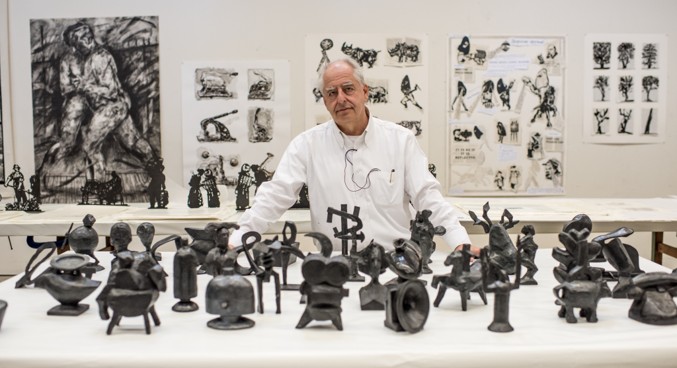
Described in the festival’s own programme notes as “not a film about Kentridge” but “a Kentridge” and built from “charcoal, torn paper, cardboard maquettes, the studio methods of a draughtsman and printmaker, set against a symphony orchestra”, the piece is played live under conductor Dmitry Sitkovetsky, who was born in Baku in 1954 and returns to his native city to open this edition as the ‘founding father’ of the festival.
“Shostakovich’s Tenth Symphony speaks in several voices at once—public and private, defiant and fearful, tragic and grotesque,” enthused Sitkovetsky. “William Kentridge does not illustrate the music; he opens another imaginative world alongside it. To bring these two powerful voices together in Baku—a city with its own deep connection to Shostakovich—expresses exactly what we want BIAF to be: a meeting place between histories, cultures and art forms.”
The programme calls it a “cardboard-and-shadow answer to the most argued-over symphony of the Soviet century”. It is a film built from “junk-model sets, torn paper and stop-motion, populated by Shostakovich, Mayakovsky, Lilya Brik and Stalin, moving through a revolution that eats its own.”
“The task of the project is to try to show within the visual film some of the ambiguities Shostakovich had to negotiate, not just in this symphony, but in all the work that he made,” said Kentridge of his work. “We have to find a way to both acknowledge the independence of the music – that it exists now in the post-Soviet era – but at the same time acknowledge the particular character of the era from which it comes.”
The pairing is certainly deliberate. 2026 marks the 120th anniversary of Shostakovich’s birth, and the festival treats the composer as, in its own words, “the century’s most useful witness and the composer who worked out how to speak in public and in private at the same time.”

Shostakovich has a genuine Baku history: he first performed there in 1934, taught several Azerbaijani composers who built the country’s modern musical school, and wove a coded tribute to his Baku-trained student Elmira Nazirova into the Tenth Symphony’s third movement with a horn call that spells out her name. Kentridge’s film is paired on the bill with Nazirova’s own Concerto on Arab Themes, co-written with Fikrat Amirov, performed by pianist Farhad Badalbeyli under conductor Fuad Ibrahimov. As the programme puts it: “The Tenth Symphony has a Baku address inside it, and the man at the piano is a living link to it.”
Even the venue, the Nizami Cinema, plays its part. It opened in 1940 as the largest picture palace in the Soviet Union, at the time of Shostakovich’s first Baku concerts and across the years of Stalin’s Terror, the period Kentridge’s film depicts. The festival’s programme notes frame the screening bluntly: “A revolution devouring its own will be screened inside a monument raised by the machine that did the devouring.”
For Kentridge, now 71, the Baku appearance extends a body of work that has carried him from Johannesburg’s apartheid-era art scene into the world’s leading opera houses and concert halls. His signature technique of filming charcoal drawings, then erasing and redrawing them so that traces of earlier marks linger in the final image, grew out of the 9 Drawings for Projection series (1989–2003) and has since underpinned stagings of Lulu, Wozzeck and Sybil, as well as Triumphs and Laments, his 550-metre frieze scoured into the grime of Rome’s Tiber embankment in 2016. His honours include the Kyoto Prize, the Dan David Prize, the Praemium Imperiale and a 2023 Laurence Olivier Award, with his work held by MoMA, the Metropolitan Museum of Art and Tate Modern, and shown regularly at the Venice Biennale and documenta. Oh To Believe in Another World has already toured major halls, including London’s Southbank Centre and the Philharmonie de Paris. Hence, Baku extends the piece’s existing international life rather than introducing it.
He spoke exclusively to TIME AFRICA from his studio in Johannesburg on a cool summer’s evening.
“I think I was first drawn to Shostakovich when I heard his First Piano Concerto, Concerto for Piano and Trumpet. And the last section of it was so astonishingly exciting and driving. When I first heard it, when I was an adolescent or a teenager, I would play it again and again. Sometimes listening to the whole concerto, sometimes jumping straight to the third movement. And in fact, the first animated film I put sound to, a film called Exhibition in 1988, used this last movement of Shostakovich in it. Since then I’ve used different pieces of Shostakovich in other pieces of music.
“The fact that he was so close to filmmakers, that he played the piano for silent cinema, that he wrote music for films, means that he’s a very visual composer. There’s something in the music that invites one to look, to see. It enlivens the images one uses. So I have a very strong connection to the music, and an interest in Shostakovich and the impossible position he was in in the Soviet Union during almost all his years as a composer. And the music of course reflects the part which is, so to speak, state music, and this part of the music which is completely oblivious or antagonistic, at times, to the state control.”
The premiere of Oh To Believe in Another World took place four years ago in 2022, yet Kentridge feels that the piece remains current: “I don’t think it’s at a completely different point given the time that has passed since 2022. Different wars have broken out, different things have happened, but the questions of Shostakovich and its relation to state music, to the state, is the same.
“So I think, obviously, the film stays identical, but one shifts one’s position and one sees it from a slightly different angle. I’m so deeply connected to it that it’s very difficult for me to see it in this different way. But I’m sure if I look back on it in a couple of years, not having seen it, certain other elements will come through. But I hope that in its uncertainties and ambiguities, it nonetheless is intriguing for audiences in Baku.”
BIAF’s second edition has built on the huge success of its inaugural festival in 2025. It is also demonstrating great ambition as the organisers are proud to announce the assembling of companies “from St Petersburg and from Jaffa, from Tbilisi and from London, from Monte-Carlo and from Johannesburg, appearing within days of each other on the same stages, before the same audience.” This has framed the festival as a deliberate act of cultural bridge-building at a moment, in the programme’s words, “when much of the world is sorting itself into camps.”

Kentridge’s presence gives that ambition a distinctly African anchor and a signal that the festival’s cross-continental reach extends well past its immediate Caucasus and European circuit, and that a South African artist’s visual language now sits comfortably alongside Europe’s most argued-over symphony, performed a few steps from where Shostakovich himself once played.
Oh To Believe in Another World screens at Baku’s Nizami Cinema. For full details on the Baku International Arts Festival, visit: www.biaf.az
To discover more of Azerbaijan’s cultural heritage and travel experiences, visit Azerbaijan.travel and follow @ExperienceAzerbaijan #experienceazerbaijan